Score
Multidisciplinary artist Murugiah on why your most personal work is always the most creative
Murugiah's journey emphasizes that the most personal work often leads to the most creative outcomes, suggesting that brands should encourage authenticity and individuality in their creative processes. By integrating personal experiences and cultural heritage into their narratives, brands can foster deeper connections with their audiences, ultimately enhancing their brand strategy.
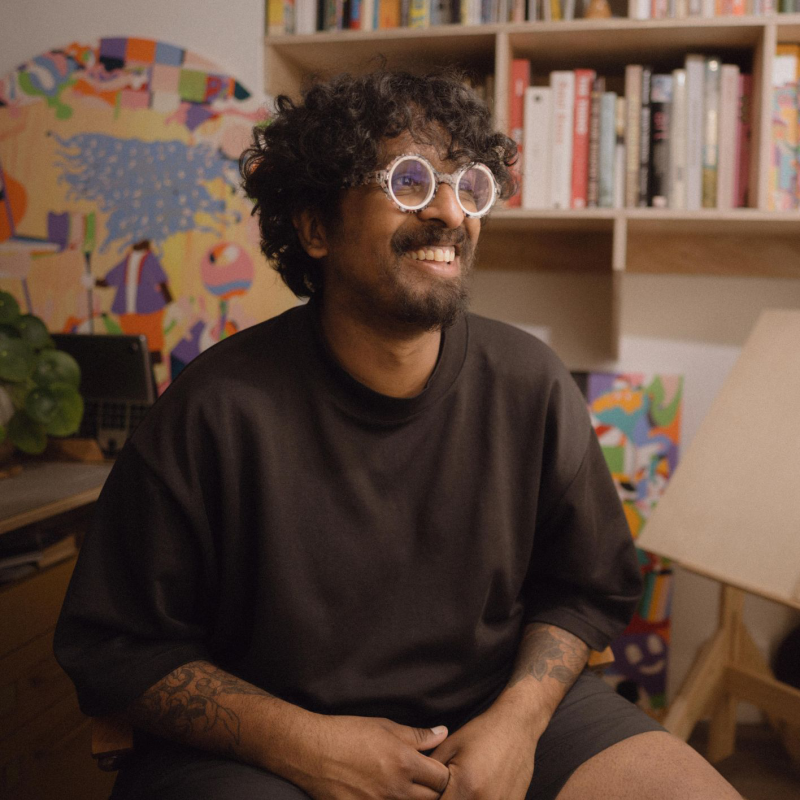
Creative Boom: Insight Art & Culture Multidisciplinary artist Murugiah on why your most personal work is always the most creative The London-based artist behind the Quentin Blake Centre's debut solo show talks to us about parent pressure, pandemic breakthroughs and learning to stop making other people's art. Written By: Tom May 16 June 2026 Murugiah. Image credit: Jack Woodhams On day one of his first solo exhibition, hosted at London's Quentin Blake Centre for Illustration, the multidisciplinary artist Murugiah did something unconventional: he showed up.
In practice, most artists tend to stay away, spooked by the fear of watching strangers encounter their work for the first time. Murugiah, however, stationed himself in the gallery. The first visitor to walk in looked around, slightly bewildered, and asked which way to go. He pointed her upstairs. She asked, with polite uncertainty, whether she was supposed to know who he was. "No," he told her. "This is my debut show, so enjoy it." Then he went and sat in the café. Half an hour later, the visitor came and found him. She sat down and spoke with him for 20 minutes about his work.
"I didn't know who you were before," she told him, "but I definitely know now." It's the kind of moment that's impossible to engineer, but for Murugiah, it meant something profound. That work rooted in genuine personal truth can reach people who've never heard of you, on its own terms, without any of the machinery of reputation. And this idea, that the most personal work is always the most creative, sits at the heart of everything he's been building towards.
Murugiah was speaking as part of The Studio, Creative Boom's membership community for working creatives, and what came across most strongly, beyond the charm and the self-deprecating humour, was the rigour underneath. This is a creative who's spent years deliberately, and sometimes painfully, figuring out what he actually wants to say, and who's arrived at a genuinely unusual place. A creative practice rooted in personal truth that also happens to be commercially thriving. The crucial pivot Murugiah trained as an architect. Not for a year or two, but for a full seven.
He emerged qualified and, as he puts it, looking one way while feeling quite another. "Losing all of your hair from stress of a seven-year course suggested that maybe that subject wasn't the right thing to continue with," he says, with characteristic dryness. He'd loved art and design since school and had asked his parents if he could pursue it at 18, but had been firmly steered towards something more dependable. When he eventually left architecture in 2012 and told his parents he was going back to illustration, their response was more resignation than enthusiasm. "Just do what makes you happy," they sighed. He took it.
What followed was a decade of learning, iteration and accumulated frustration. He worked in-house at a greeting card company. He created packaging for a restaurant chain, designed crisp packets, and learned about kerning. He developed a freelance illustration style that was technically accomplished, which led to editorial work and a book project illustrating scenes from films. And then he stopped, looked at what he'd made, and felt… nothing. "I just felt so inauthentic making this work," he says. "I was like: 'This is not the way I think. This is not the way my work should be.'" That reckoning came just before the pandemic.
Article truncated for readability. Read the full piece →
The article provides valuable insights into the importance of authenticity in branding, which is relevant for brand strategy professionals, but the concepts discussed are not entirely new or groundbreaking in the industry.