Score
These fake AI ads are perfectly soulless
The rise of vague and cryptic AI advertising highlights a significant disconnect in brand communication, where many ads fail to resonate with the general audience. For brand strategy, this underscores the importance of clarity and distinctiveness in messaging, particularly in a crowded tech market where authenticity can set a brand apart from its competitors.
FastCompany: There’s a specific voice and vagueness to technology advertising today . The ads are often for startups you’ve never heard of selling a service or software that’s somehow related to AI . And while the ad voice is direct, in that it’s written as if it’s speaking directly to you, the viewer, the copy is intentionally cryptic. “Own Your Inference.” “Put AI Agents to Work for People.” Sometimes it’s menacing. “Stop Hiring Humans.” These kinds of ads seem to be everywhere lately, but that doesn’t mean that they make much sense.
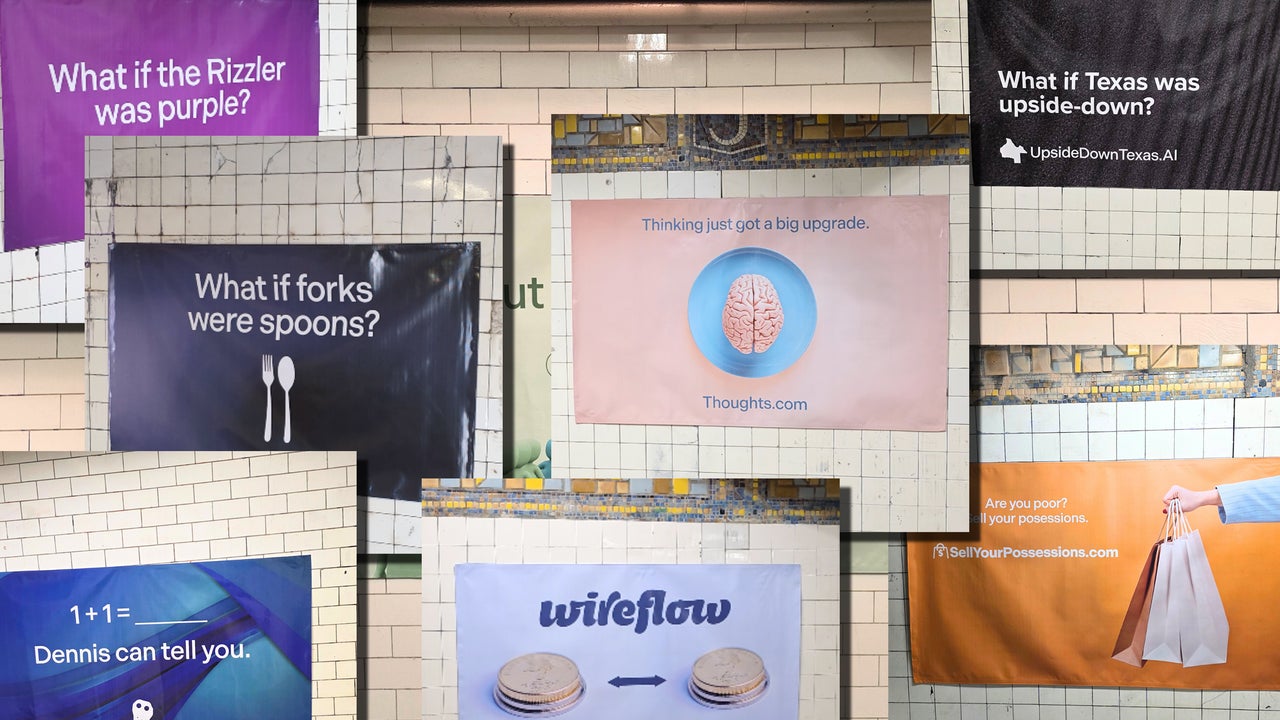
Now, comedians Harris Alterman and Dave Ross are emphasizing just how banal and meaningless the AI ad age is turning out to be by creating their own fake tech ads that skewer the medium simply by amping up its tropes: AI industry gobbledegook and design minimalism. [Photo: courtesy Harris Alterman and Dave Ross] The ads, which they put up as banners in a New York City subway station (much like the controversial, real ads for the AI companion Friend last fall ) ask asinine questions.
“What if forks were spoons?,” “What if Texas was upside-down?,” and “What if the Rizzler was purple?” One fake ad is for a company with a human name, “Dennis.” [Photo: courtesy Harris Alterman and Dave Ross] Another advertises a faux company that recently rebranded. “Zipline is now Froggle,” the ad says matter-of-factly.
“The cloud-based online safety you know and love, now in the palm of your hand.” An ad for a brand called Fivetable confidently states “We Put the Q in QR1777,” and Wireflow promises “you pay us, we pay you.” [Photo: courtesy Harris Alterman and Dave Ross] Alterman and Ross were especially inspired by a real ad for the product development software company Linear, which shows cursors pointing toward God’s outstretched hand, as in Michelangelo’s “The Creation of Adam,” and another for Dawn, an AI mental-health app, that says “Racing Thoughts Don’t Do Waiting Rooms.” [Photo: courtesy Harris Alterman and Dave Ross] They call the lack of distincti
veness around AI advertising in its design, voice, and fonts “slop voice,” and note that while these ads sound like they’re speaking to you, they’re really talking to someone else: a high tech, SaaS-speaking in-group . And it’s ok if the copy alienates everyone else. [Photo: courtesy Harris Alterman and Dave Ross] “People are confused by tech advertising,” they tell Fast Company in an email. “99% of the people reading these ads have no idea what they’re talking about. It feels like 20 people in tech, advertising to 20 other people in tech. Do you really need to put up ads?
Can’t you guys just get in a group chat together?” [Photo: courtesy Harris Alterman and Dave Ross] That’s how Alterman and Ross made their ads, after all. The comedians wrote them together. Ross then designed the ads in Photoshop and made websites for them using HTML/CSS and Javascript. While their fake ads aren’t for real tech companies, they are selling something. The comedians put up a merch shop under their brand called Goofstump. Alterman says they plan to make more fake ads , and they’d like to partner with the MTA to make an official art installation.
Article truncated for readability. Read the full piece →
The article addresses a growing concern in brand communication due to AI, making it significant for the industry, while also providing relevant insights for brand strategy professionals on the importance of clarity in messaging.
Weekly digest
Get the Signal digest
Every Monday morning — the top 3 brand trends, 10 high-signal articles, and one emerging signal to watch.
No spam. Unsubscribe anytime.