Score
How a character from ‘The Addams Family’ is shaping the future of robotics
The development of a self-contained robotic hand inspired by 'The Addams Family's' Thing represents a significant shift in robotics, emphasizing modularity and independence in robotic design. This innovation could lead to more sophisticated and versatile robotic systems capable of operating in confined spaces without the need for a full humanoid body, paving the way for future applications in various industries.
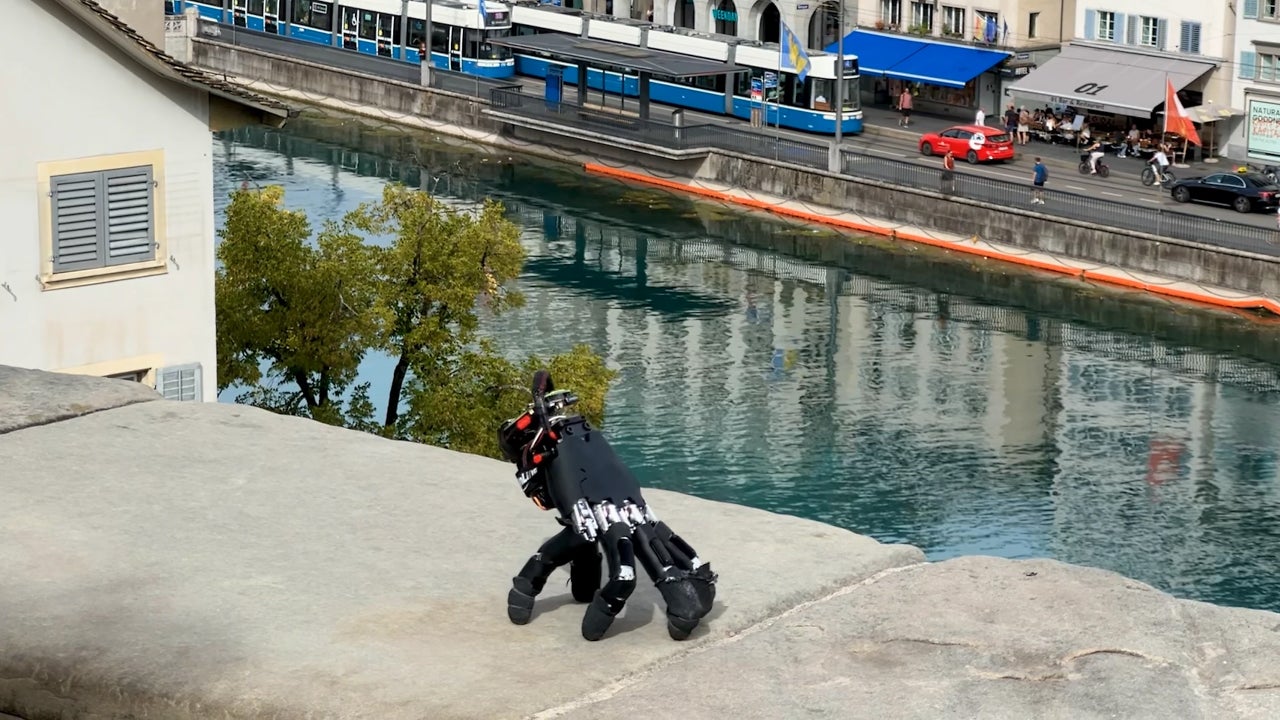
FastCompany: Robotic hands usually come bolted to the wrist of a mechanical arm, waiting for their humanoid owners to move them over to whatever knob or valve needs turning. However, at ETH Zürich’s Soft Robotics Lab , a group of roboticists decided to get rid of the body, designing a self-contained hand that crawls across surfaces, balances its own weight, and manipulates objects using only its five digits. It may seem like an awesome-but-useless robotic recreation of Thing , The Addams Family ’s famous disembodied butler.
And while Amirhossein Kazemipour, a PhD candidate at the lab, tells me via email that Thing was part of the inspiration—“I love the Addams Family! :-)” he writes—the truth is that this walking hand can become a new key feature in the future of robotics. Enabling parts to function independently of a whole means more sophisticated operating capabilities. Kazemipour is one of the three researchers behind the project, alongside Hehui Zheng and Robert Katzschmann, who recently wrote a paper detailing how their invention solves an enduring dilemma in robotics: creating a system that can move and dexterously interact with objects.
When autonomous systems need to inspect equipment or flip switches inside cramped enclosures, their operators are typically forced to thread long, unwieldy mechanical booms through the gap or park bulky rovers right at the threshold. “The idea is to give a hand some independence,” Kazemipour tells me. “Usually, an arm carries it to do the job.
We wanted the same fingers to handle getting there, keeping the hand balanced, and interacting with things.” Plus, by training the digits to pull double duty as walking legs, the engineers at ETH Zürich—a Swiss public research university—bypassed the extra weight, complexity, and mechanical failure points of dedicated wheels or secondary limbs. Teaching a humanoid hand to march like a scurrying spider, however, presents distinct kinematic hurdles. Getting uneven physical joints to bend and carry their own weight was a geometric and mechanical headache, according to the paper.
Standard legged platforms, like Boston Dynamics’s quadrupedal robot dog Spot , benefit from bilateral symmetry, meaning their left and right halves are mirrored pairs that share balanced dynamic loads across a level frame. But an anthropomorphic hand possesses no such geometry. It has an opposed thumb, four digits of noticeably different lengths, and a palm that naturally rests at a lopsided angle.
The researchers discovered that when they applied standard quadruped gait rewards—the scoring formulas that train four-legged robots how to step—to an off-the-shelf gripper, the fingers dragged their fingernails across the floor or splayed uncontrollably, struggling to stay upright on their soft fingertip pads. AI to the rescue To solve the anatomical riddle, the researchers devised an ingenious software that mathematically cancels out the palm’s resting slant so the hand always understands which way is flat, without restricting its natural motion.
Article truncated for readability. Read the full piece →
The article discusses a unique application of pop culture in robotics design, which could significantly influence the industry, while also providing insights relevant to brand strategy professionals interested in innovation.
Weekly digest
Get the Signal digest
Every Monday morning — the top 3 brand trends, 10 high-signal articles, and one emerging signal to watch.
No spam. Unsubscribe anytime.