Score
Anduril isn’t just building the future of warfare; it’s redesigning it
Anduril is redefining the defense industry by integrating innovative design principles into its product development and marketing strategies, aiming to create a brand that resonates with modern consumers and military buyers alike. By positioning itself as a forward-thinking company akin to tech giants like Apple and SpaceX, Anduril seeks to reshape perceptions of military technology, making it more appealing and aspirational for a new generation. This approach emphasizes the importance of design in every aspect of the business, from product aesthetics to user experience, ultimately aiming to foster a sense of confidence and excitement around its offerings.
FastCompany: What’s the closest you’ve ever stood to a drone? I’m not talking about a cute quadcopter, but a military-grade death machine that can carry enough warheads to obliterate a bridge, a tank, or a building? Sure, I’d heard of them. I’d seen them on the news. I’ve closely followed the paper, scissors, rock war in Ukraine where every six weeks the Ukrainians or Russians break the rules with new drone hacks. But it wasn’t until I was standing in front of the Fury, an autonomous plane meant to fly alongside F-16s and other military jets, that our Terminator era of warfare really hit me.
This thing looks mean in an unknowable way, like a deep-sea predator that’s shed its gills and taken to the skies. It’s hard to look at the Fury without feeling a little afraid, and even a little disgusted. And yet for all my qualms around military spending and my dreams about a peace-filled world without war, ultimately I respond exactly like I’m supposed to: I’m relieved that the Fury is on our side. Or I should say, it can be, for a price. I’m standing next to Jen Bucci, the leather-jacket-clad head of design at Anduril, America’s hottest defense startup.
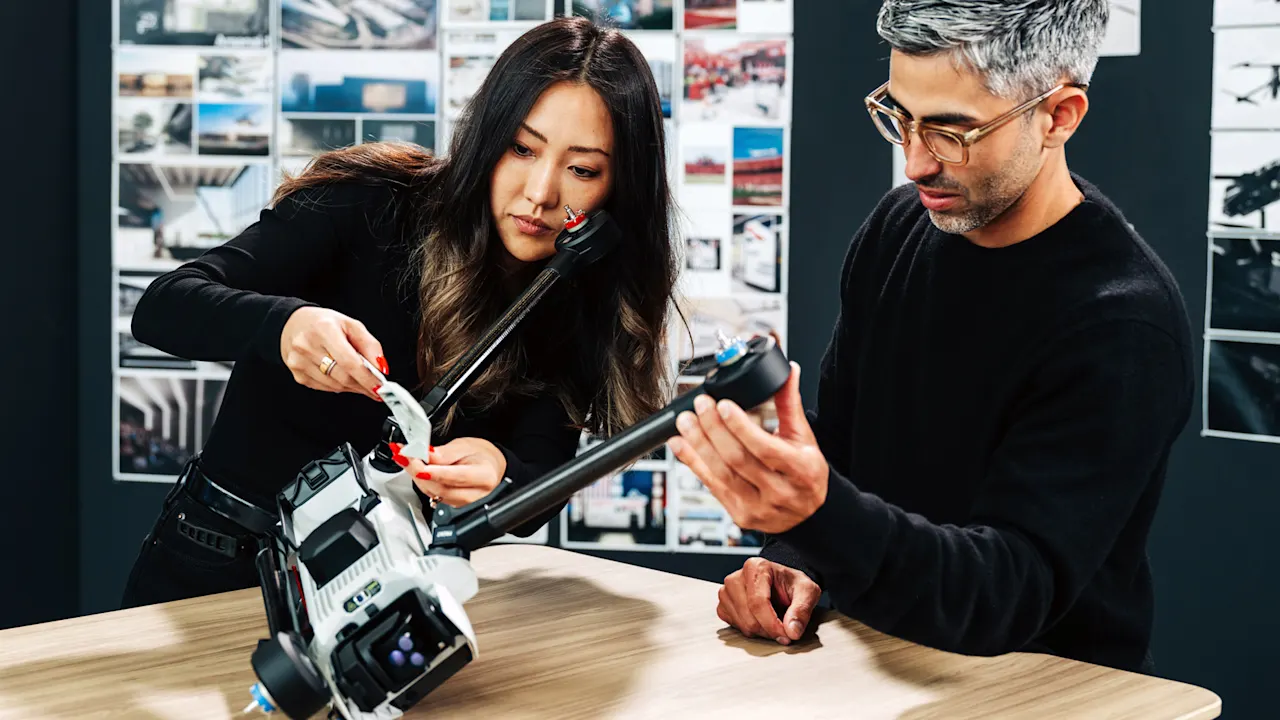
She’s giving me a tour of the showroom, which looks a little like a Costco, with its unadorned concrete floors and stockpile of products—in this case, underwater missiles, an autonomous submarine mothership, and a variety of vertical-launching drones—that are sold in bulk. We’re heading toward the design lab, where Bucci’s team of 50 designers help craft the look and feel of Anduril’s offerings, from the shape of the weapons to the way they’re marketed. I’m the first journalist to be invited inside, and from the moment I step into the space, it’s clear Anduril isn’t interested in being a traditional defense contractor.
Anduril is a defense manufacturer founded in 2017 by technologists Palmer Luckey, Brian Schimpf, Trae Stephens, Matt Grimm, and Joseph Chen—a group of technologists and venture capitalists with strong ties to the secretive surveillant software company Palantir , which powers the ImmigrationOS software used by the U.S. Immigration and Customs Enforcement agency. While the traditional “Primes” like Northrop Grumman, Boeing, and Lockheed Martin court mega government contracts to develop new weapons, Anduril acts more like a traditional product company.
It forecasts the wars of tomorrow, spending hundreds of millions of its own funds to develop and acquire a range of interoperable (oft autonomous) products that it bets are too irresistible for the government to pass up. [Photo: José Mandojana for Fast Company ] It’s easy to see how this vision plays out in the showroom. Each weapon is painted in matching gunmetal tones and accented in Chrysler “national safety yellow” (a hue that sits in the spectrum of “world’s most visible color” while giving the weaponry an enticing, Nike-like glow). A simple, machined curve is mirrored across products.
As I eye a 13-foot underwater Copperhead missile in one corner, I realize how it could slot right into the expandable Dive-XL submarine in the other. [Image: courtesy Anduril] I mention to Bucci that the model feels like Apple; the more you buy, the more you want to buy. She agrees, but points out that it also fits the Android model when analyzing the actual technological stack, because other products can plug into Anduril’s Lattice software, which maps conflicts in real time by treating every connected device as another data source. So far, Anduril is a fraction of the size of its traditional competitors.
Article truncated for readability. Read the full piece →
Anduril's approach to integrating innovative design principles into the defense industry is significant and relevant for brand strategy professionals, as it challenges traditional perceptions and practices in a sector typically resistant to change.
Weekly digest
Get the Signal digest
Every Monday morning — the top 3 brand trends, 10 high-signal articles, and one emerging signal to watch.
No spam. Unsubscribe anytime.