Score
Rome’s Colosseum got a revamp to reveal a long-hidden history
The recent restoration of the Colosseum's southern side emphasizes the importance of historical accuracy in brand strategy, showcasing how architectural interventions can enhance visitor experiences and foster deeper connections to cultural heritage. By revealing the monument's original layout and improving accessibility, the project not only preserves history but also revitalizes the brand of the Colosseum as a living symbol of Rome's grandeur.
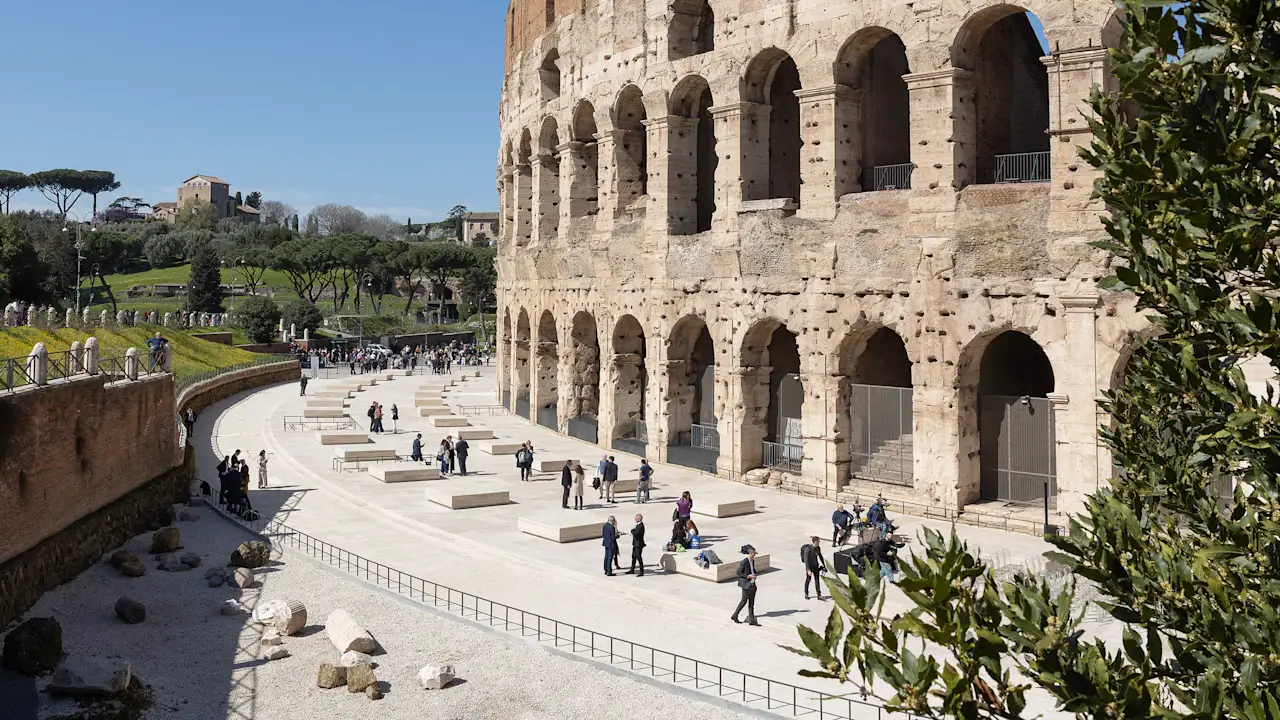
FastCompany: The southern side of the Colosseum in Rome has just undergone a subtle but much-needed facelift. This side of the world-famous monument is where the empire’s elite once entered the grand amphitheater to watch gladiators fight to the death, and where a series of earthquakes over its nearly 2,000-year lifespan have chewed away at the structure. Through deep archaeological research and a clever architectural intervention, the ancient monument’s original layout has been restored after centuries of decay. It’s giving modern day visitors a more accurate sense of how the space was originally used.
The project focuses on the southern perimeter of the Colosseum, restoring of the original ground levels of the outer arcades and rebuilding the plaza-like crepidine, a two-step base wrapping around the edge of the building. New paving at this end of the monument offers visitors a more accurate understanding of the Colosseum’s layout when it was completed in the year 96, recreating the physical experience of approaching the entrance to the amphitheater just as Roman emperors would have many centuries ago. The work was led by Stefano Boeri Interiors in conjunction with the Parco Archeologico del Colosseo .
It’s based on decades worth of archeological research into the original extent of the Colosseum, which has been carved away over time by the development of Rome and the slow decay of the monument itself. [Photo: Simona Murrone] “The perimeter of Colosseum was not clear,” says architect Stefano Boeri, known for his tree-covered Bosco Verticale towers in Milan. “The emperor used to enter from that side. So it’s very important.” Building on previous work he has done designing a new access point to another part of the Colosseum’s campus , Boeri was sensitive to the historic importance of the site, and of not overshadowing it with new elements.
“When you step on the crepidine, you have the feeling of being inside the monument, because what you are walking on, the ground is exactly the same as what we had 2,000 years ago,” Boeri says. “We wanted to create for every visitor the real perception of the dimension of the monument, the true perception of its proportions.” A lot of that work required hinting at what has been missing from the monument for centuries. Earthquakes and erosion have badly damaged the Colosseum over time, wiping out the two outermost arcade rings on its southern side. Boeri’s design for the crepidine reveals the ghosts of that long-long side of the building.
“We decided to superimpose in the new pavement a system of very abstract rectangular white marble blocks that were located exactly in the position of the pre-existent pillars that were sustaining the arcs for the corridors,” he says. “This is to give the idea to the people that they are entering, in a way, the monument.” [Photo: Simona Murrone] The shape of the paving stones used in this area is also a reflection of the monument’s form, with trapezoidal slabs of marble aligned exactly with the arched entries that ring the amphitheater. Though the restoration was guided by historical accuracy, it’s also looking to the future.
Restoring the monument’s original levels offered the opportunity to rework its stormwater drainage system, routing water through the site and preventing further erosion. The project expands the public space that surrounds the monument by about 33,000 square feet—adding freely accessible space in a part of the monument that was long blocked off from use and filled with ruins. “We have introduced a different border. People can enter without having to buy a ticket,” Boeri says. “So the public can come closer to the monument.
Article truncated for readability. Read the full piece →
The restoration of the Colosseum is significant for the brand/design industry as it highlights the intersection of historical preservation and brand strategy, making it relevant for professionals focused on cultural heritage and visitor engagement.