Score
Forget the fridge: Studio Mol on why your children's artwork deserves to be properly framed
Studio Mol's Aperture Art Frames elevate children's artwork by framing it with a minimalist design that highlights the creativity of young artists while integrating it into adult spaces. This approach not only values children's artistic expressions but also reinforces the importance of thoughtful design in personal spaces, suggesting that brands can find success by merging functionality with emotional resonance.
Creative Boom: Resources Tools Forget the fridge: Studio Mol on why your children's artwork deserves to be properly framed Aperture Art Frames answers a question every creative parent will recognise: why aren't we treating our children's earliest creativity with the same care we'd give any other art? Written By: Tom May 1 June 2026 There's a special kind of guilt creatives all know well. You spend the working day thinking carefully about composition, colour and how objects sit within a space. Then you go home, Blu-Tack your kid's drawing to the fridge, and leave it there until it curls at the corners.
Not because you don't value it, but because no one's found a better solution. Well, Hannah Fleetwood and Sophie Charles, both new mothers, decided to do just that. With backgrounds in textiles and graphic design, the co-founders at Edinburgh studio Studio Mol came up with the Aperture Art Frame: a handmade paper art piece that takes a child's early mark-making and sets it within a precisely composed, minimalist paper assemblage. The concept is rooted in something artistic parents tend to notice: those first drawings, the tentative circles and joyful, unselfconscious colour, are genuinely expressive.
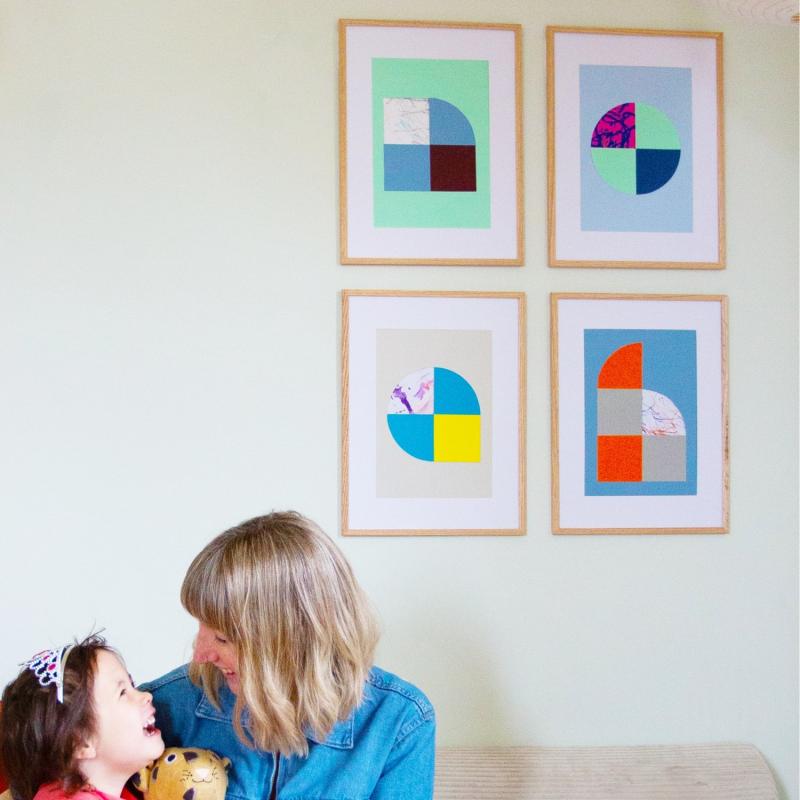
They're also, as Hannah puts it, "transient" by default: stacked in piles, pinned haphazardly to the fridge, or just bunged in a drawer. Aperture Art Frames are built around the conviction that they deserve better. What's clever about them is that, rather than displaying a child's drawing in its entirety, each frame uses a carefully cut aperture to select and elevate a portion of it. This reframes the composition as a window into the work, rather than a simple display of it.
It's a small but significant distinction, and it's the move that shifts these pieces from keepsake into something that sits comfortably alongside other considered objects in the home. And while it might sound like a simple idea, there's a lot of thought and consideration that goes into making them in practice. Design thinking Hannah describes the production process as sitting "somewhere between design, making, and a form of quiet curation". Each frame begins with a considered composition: proportion, colour, negative space, and how the piece will sit within a wider interior.
The paper is FSC-certified, and the hand-cutting and layering are done slowly, in the studio, with a tactile care that Hannah explicitly contrasts with the pace of digital production. The geometric paper assemblages that surround the child's mark-making are bold and confident in their own right, working with clean shapes, arcs and quadrants in a palette that manages to be both lively and calm. The look owes something to the mid-century tradition of collage, something to contemporary Scandi design, and something to the kind of abstract print you might find in a thoughtfully curated independent gallery.
The child's mark, whether that's a swirling crayon line or a broad, exploratory scribble, sits within that context not as an anomaly, but as the focal point the whole composition is built around. The tension that makes it work The most compelling thing about the Aperture Art Frames, and the thing that will resonate most with creatives, is the tension at their core. Children's early mark-making is instinctive and unfiltered; the paper assemblage surrounding it is measured and restrained. The skill of the design is precisely in making that relationship feel inevitable rather than forced.
Article truncated for readability. Read the full piece →
The article presents a unique approach to framing children's artwork that combines design and emotional value, making it significant for brand strategy professionals interested in innovative product design and consumer engagement.