Score
This cool interactive visual argues that generative art began in a cave
The article discusses 'The Living Timeline,' an interactive history of generative art launched by Le Random, which traces the evolution of generative art from ancient times to the present. It highlights the significance of relinquishing creative control to algorithms and how this practice has persisted throughout art history, culminating in today's AI-generated art. Brand strategists can take away the importance of understanding historical context and the evolution of creative processes when integrating new technologies into their brand narratives.
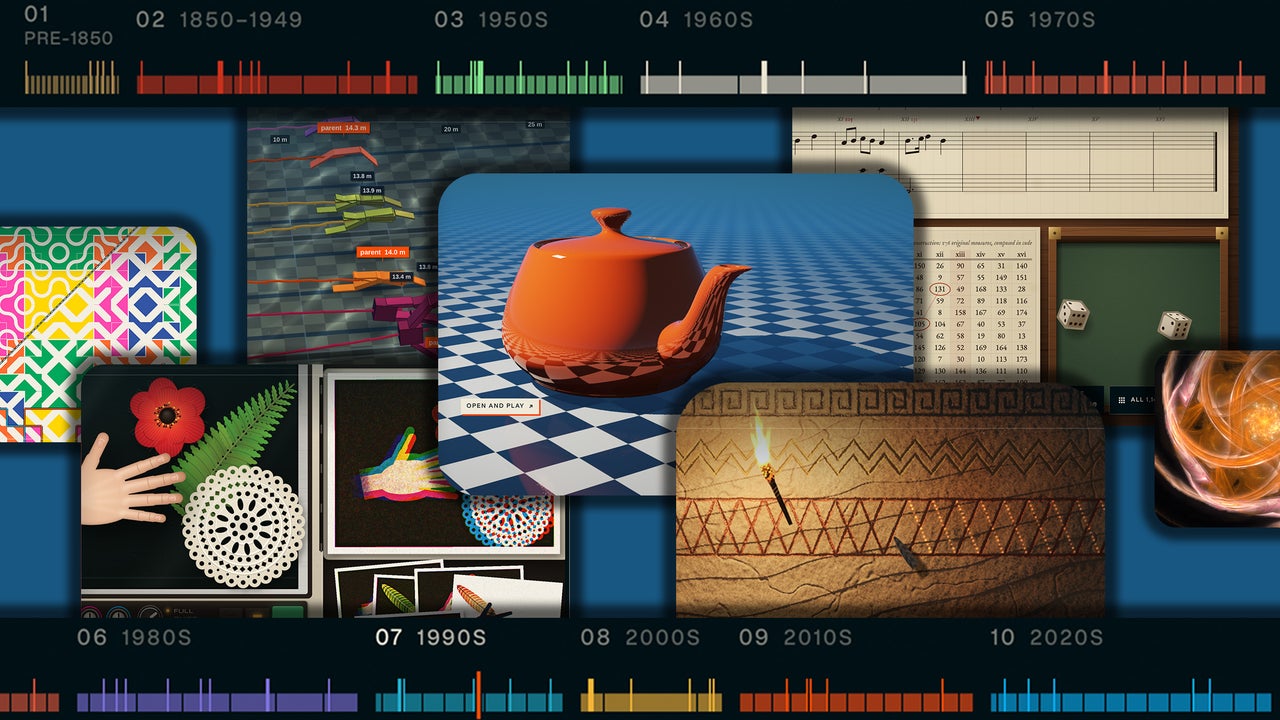
FastCompany: Around 71,000 BCE, someone in a place now called Blombos Cave, on the southern coast of what is now South Africa, scratched crosshatched lines into a piece of ocher. No computer. No code. No prompt. But according to The Living Timeline , launched by digital art institution Le Random , the drawing is a work of generative art, just like your latest AI -styled photo on Instagram. The Living Timeline is an interactive history of generative art, with 1,147 moments running from 71,000 BCE to 2026 that cover artworks, ideas, and exhibitions connected to the human-made algorithms and machines that made them possible.
It includes examples as disparate as those primitive etchings, the 1804 invention of the jacquard loom , and a video processor from 1974. According to Peter Bauman, editor-in-chief at Le Random, the timeline “helps explain to people outside of the space why certain works are important.” He believes you can’t judge 1960s plotter art by its appearance alone, for example, because “you also have to consider the context, and how difficult every single thing they were doing at the time was.” Bauman wrote The Living Timeline with contributions from Sasha Stiles —a Kalmyk American poet and AI researcher—and Vuk Ćosić, a Slovenian pioneer of the 1990s
net.art movement known for his ASCII-based work . [Screenshot: Le Random ] Take those 73,000-year-old crosshatched lines in the Blombos Cave, the first known drawing by humans and the first entry in the timeline.
According to art theorist Philip Galanter, professor emeritus at the Texas A&M University College of Performance, Visualization & Fine Arts, “They qualify as generative because the placement of individual marks has not been decided by the artisan, but dictated by a manually executed symmetry‐based algorithm.” Galanter’s definition of generative art— published in a research paper in 2003 —strongly influenced Bauman’s own definition, which in turn influenced the timeline.
Generative art is an art practice in which an artist uses a system (natural-language rules, a computer program, a machine, or another procedural method) that contributes to or completes the work. [Screenshot: Le Random ] Galanter’s thesis that generative art “is as old as art itself” is a provocative, but solid, idea. Still, it doesn’t mean that all art is generative. To know what’s generative you have to ask a simple question: Did the artist give a rule, process, material, or machine some room to make decisions?
The timeline does that, connecting generative art to looms, music composed with dice, code-controlled plotters, and neural networks. The artist creates a system, and if the system helps or makes something, that’s generative art. By that general rule, however, I can see many different rules or algorithms used to create art through the ages, from the realism provided by the perspective grids and optical mirrors that dictated the appearance of a masterwork like Diego Velázquez’s Las Meninas to the strict geometric and chromatic limits rules set by Piet Mondrian for his de Stijl-style paintings.
Article truncated for readability. Read the full piece →
The article presents a unique perspective on the historical significance of generative art, which is relevant for brand strategists looking to integrate technology into their narratives, but it may not have a broad impact on the industry as a whole.
Weekly digest
Get the Signal digest
Every Monday morning — the top 3 brand trends, 10 high-signal articles, and one emerging signal to watch.
No spam. Unsubscribe anytime.