Score
Google’s Workspace icons just got the ‘AI gradient’ treatment
Google's redesign of its Workspace icons introduces a gradient aesthetic that signifies a shift into the AI era, moving away from the flat design that dominated the late 2010s. This trend reflects a broader industry movement where tech companies are adopting gradients to convey approachability and modernity, ultimately signaling compliance with established digital norms in the AI landscape.
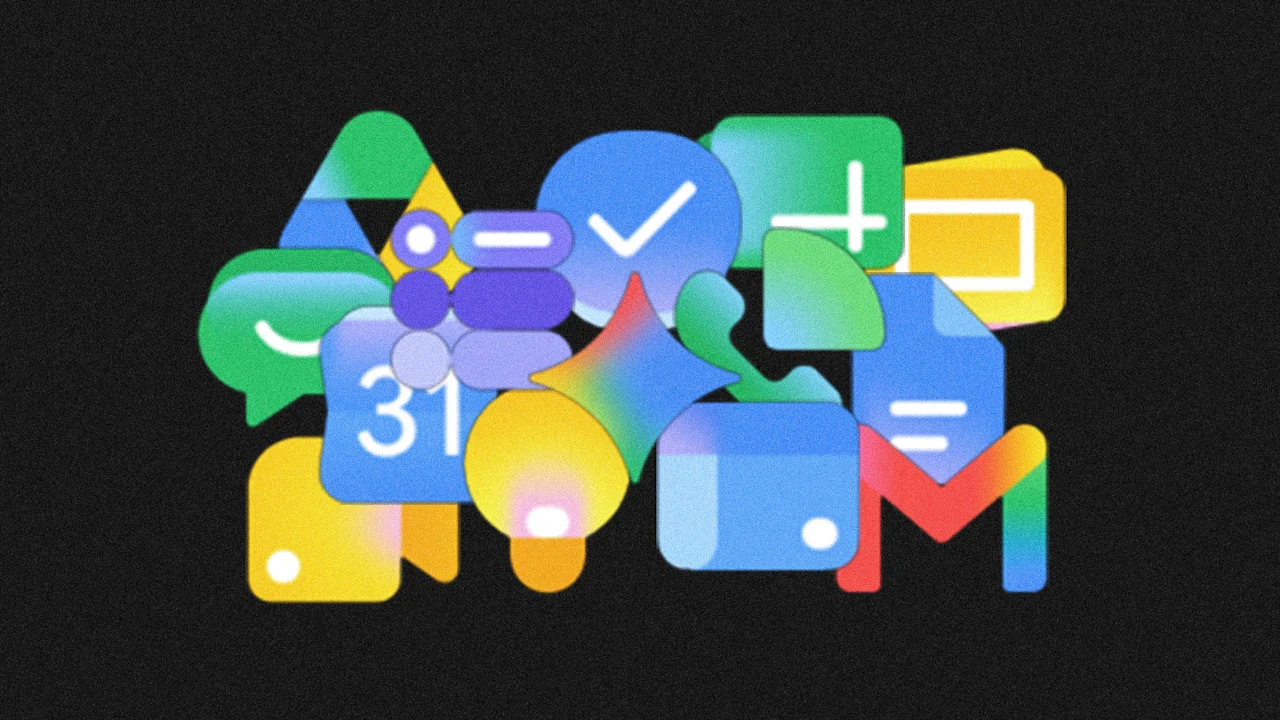
FastCompany: Google is quietly rolling out a redesign of the logos for its Workspace apps, including Gmail, Google Docs, and Google Drive. They now look like they’ve been run through a watercolor filter. Each new logo in the suite—which began showing up on May 18 on the web, Android, and iOS—is softer and rounder than its predecessor. What really stands out, though: Every single icon has been given some sort of color gradient.
[Images: Google] Gmail now smoothly transitions through Google’s brand palette of primary colors and green; Google Meet and Google Chat have lost the full palette in favor of yellow and green aura schemes, respectively; and Google Docs has gone from a flat blue to a subtle fusion of blue and purple. [Images: Google] This is the first time Google has updated its Workspace icons since 2020, and it’s a clear effort to visually denote its shift into the AI era. More broadly, the pivot confirms a trend that Fast Company predicted back in October : The gradient is emerging as the defining color schematic of the AI era.
According to Ben Sherwood, creative partner at the agency Design Bridge and Partners, we’re currently witnessing a collective pivot from the “stark simplicity of flat design” toward “what could be termed the ‘AI gradient everywhere’ aesthetic.” Buttholes, voids, and sparkles Since ChatGPT debuted in 2022, designers have faced the novel challenge of figuring out how to visually represent a technology as powerful and amorphous as AI in a way that sparks curiosity rather than skepticism. [Image: Google] Several distinct logo shapes have already solidified themselves as hallmarks of the early AI transition—some almost to the point of parody.
There are the plain circles used by Meta and Grok; the twinkling sparkle that appears on Google’s Gemini chatbot, Adobe Photoshop’s generative image filler, Grammarly’s language fixer, and Wix’s auto website maker; and the swirling, nebulous void used by OpenAI, Anthropic, and Perplexity (sometimes called the “ AI butthole ”). And then there’s the gradient. Of course, gradients are nothing new; they’ve long been a motif of choice for tech companies (see Instagram and Apple Music ). But for Big Tech companies, they’ve become an almost unavoidable motif. Apple Intelligence, Google Gemini, and Meta AI all incorporate gradients in their logos.
Microsoft has added gradients to both its Copliot logo and its entire suite of Office icons . Back in September, Google reworked its iconic “G” into a four-color gradient, which it’s now following with the new Workspace icons. [Images: Google] Branding experts say there are a few factors driving the popularity of gradients in the AI space—and, for better or worse, it’s unsurprising that tech companies are flocking to them rather than aiming to stand out. Why every AI company is using gradients Surface level, there’s a practical reason that gradients are having a moment.
Drew Stocker, creative director at Pearlfisher, says advances in rendering and production technology have made gradients more achievable and consistent than ever before. “For Google, the move toward dimensional iconography feels like a natural evolution: Gradients add depth and approachability that flat color can’t, and in a digital-first context, the execution is well within reach,” Stocker says. Moving away from flat color carries the added advantage of allowing tech companies to signal a clear departure from tech’s late-2010s mobile-transition era (defined by a minimalist aesthetic and logo “ blanding ”) into a new AI age.
Article truncated for readability. Read the full piece →
The redesign of Google's Workspace icons represents a significant shift in design trends within the tech industry, making it impactful and relevant for brand strategy professionals, though the use of gradients is becoming more common.