Score
Shunpei Kamiya Turns Ordinary Tokyo Scenes Into Images That Feel Slightly Wrong
Shunpei Kamiya's illustrations transform ordinary Tokyo scenes into surreal and humorous images, emphasizing the importance of creativity and individuality in art. For brand strategy, this approach highlights the value of unique storytelling and the ability to engage audiences through unexpected and relatable visuals, which can differentiate a brand in a crowded market.
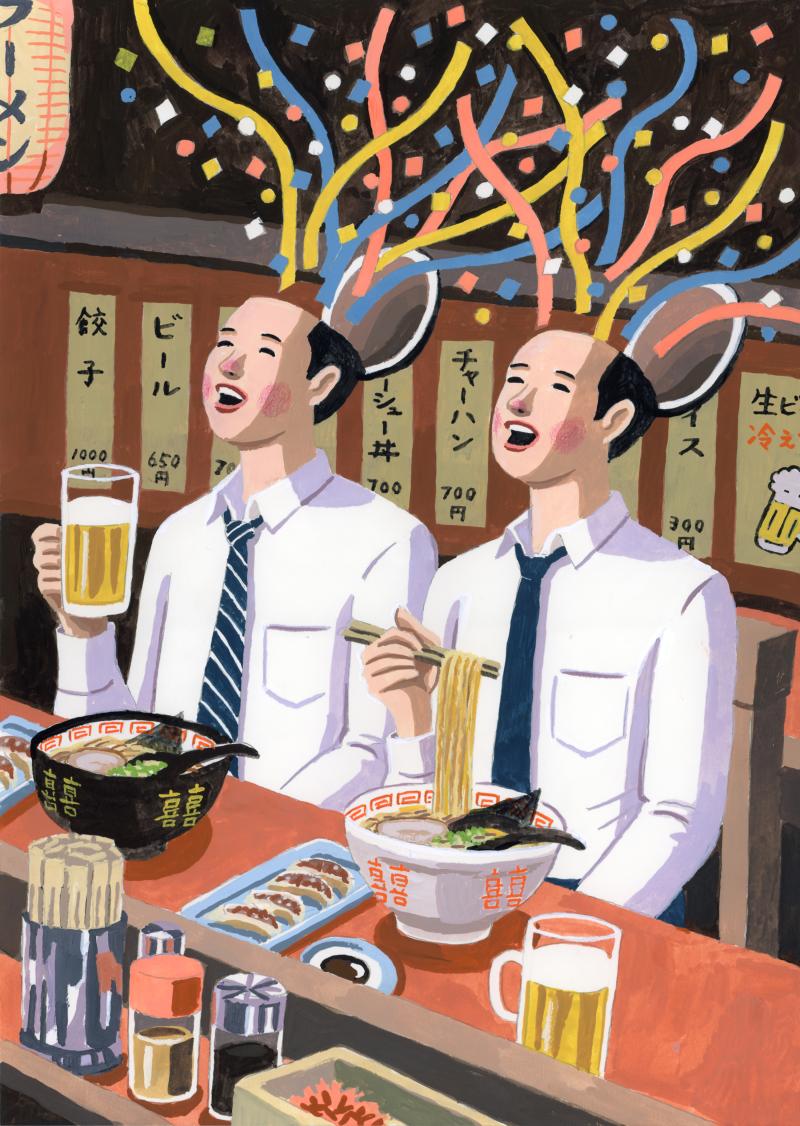
Creative Boom: Inspiration Illustration Shunpei Kamiya finds the surreal, and the funny, in everyday Tokyo From white rabbits leaping out of a 3D screen to school kids zapping each other with laser-eyed crushes, the Tokyo illustrator makes ordinary life strange, witty and wonderful. Written By: Katy Cowan 23 June 2026 At first glance, a Shunpei Kamiya illustration gives you something familiar, right out of Japan: a packed commuter train, a family posing for a selfie outside the supermarket, two salarymen slurping ramen after work. Then the world turns upside down.
White rabbits come bounding out of a 3D cinema screen while the audience gawps in paper glasses. Two teenagers lock eyes and fire crackling red laser beams across the school corridor. A man lifts his shirt in the doctor's office to reveal a clean, round hole straight through his middle. The Tokyo-based illustrator, a member of the Tokyo Illustrators Society, builds his work on that double-take, turning the most ordinary corners of modern Japanese life into surreal, funny, and sharply observed scenes using flat gouache colour in a glorious ode mashup to manga and fine art. Where does all this strangeness come from?
He says it's all about attitude. "There are already countless pictures in the world, so I feel compelled to create something that people do not usually draw," he tells Creative Boom. "Otherwise, I sometimes wonder what the point of my making pictures would be. I am not interested in being strange for its own sake. I always look for hints within ordinary daily life." Even his most eventful scenes, like the leaping rabbits and the duelling laser beams, have a curious stillness, as though caught in that moment rather than filmed. While many artists chase movement and drama, Kamiya keeps everything almost frozen.
"When people try to depict movement or dramatic moments, they often rely on photographs or paused video frames. I do not want my images to become too photographic," he says. "Photography is naturally better at capturing motion and fleeting moments. Painting and illustration are different forms of expression, and I want my work to remain within the territory of drawing rather than imitate photography. That may be one reason why my work often feels still and static." Much of the tension in Kamiya's work comes from what he chooses not to explain, and he is candid that maintaining the balance remains a struggle.
"Someone once told me that my work is very 'linguistic' and leaves little room for ambiguity. I thought that was a fair observation because my ideas often begin with words," he says. Since then, he has tried to hold back. "I have tried to remind myself not to explain too much when making an image. At the same time, there are occasions when being deliberately explanatory can create its own kind of humour or interest. Finding the right balance remains difficult." He adds, "I believe an artwork is completed when it is viewed, so I leave interpretation to each viewer," he says.
"Just because I made an image does not mean I know the 'correct' meaning of it." That openness is not the same as indifference, though. Before he starts, he spends a long time imagining how all sorts of people might read the same scene from their own angle. So where do the scenes themselves come from? Everywhere at once, it turns out. "Things I have seen, things I remember, things I imagine, and images made by other artists," he says. "All of these memories and impressions blend until a clear image forms in my mind.
Article truncated for readability. Read the full piece →
Kamiya's unique artistic approach offers valuable insights into storytelling and audience engagement, which are crucial for brand differentiation in a competitive landscape.