Score
Why beer mats beat billboards when you want to crack a social taboo like debt problems
Lowell's innovative campaign 'Say It Over a Drink' utilizes beer mats to encourage conversations about debt, a typically taboo subject. This strategy highlights the importance of context in brand communication, suggesting that subtle, relatable prompts can foster openness and support among individuals facing financial difficulties, ultimately enhancing brand engagement and social responsibility.
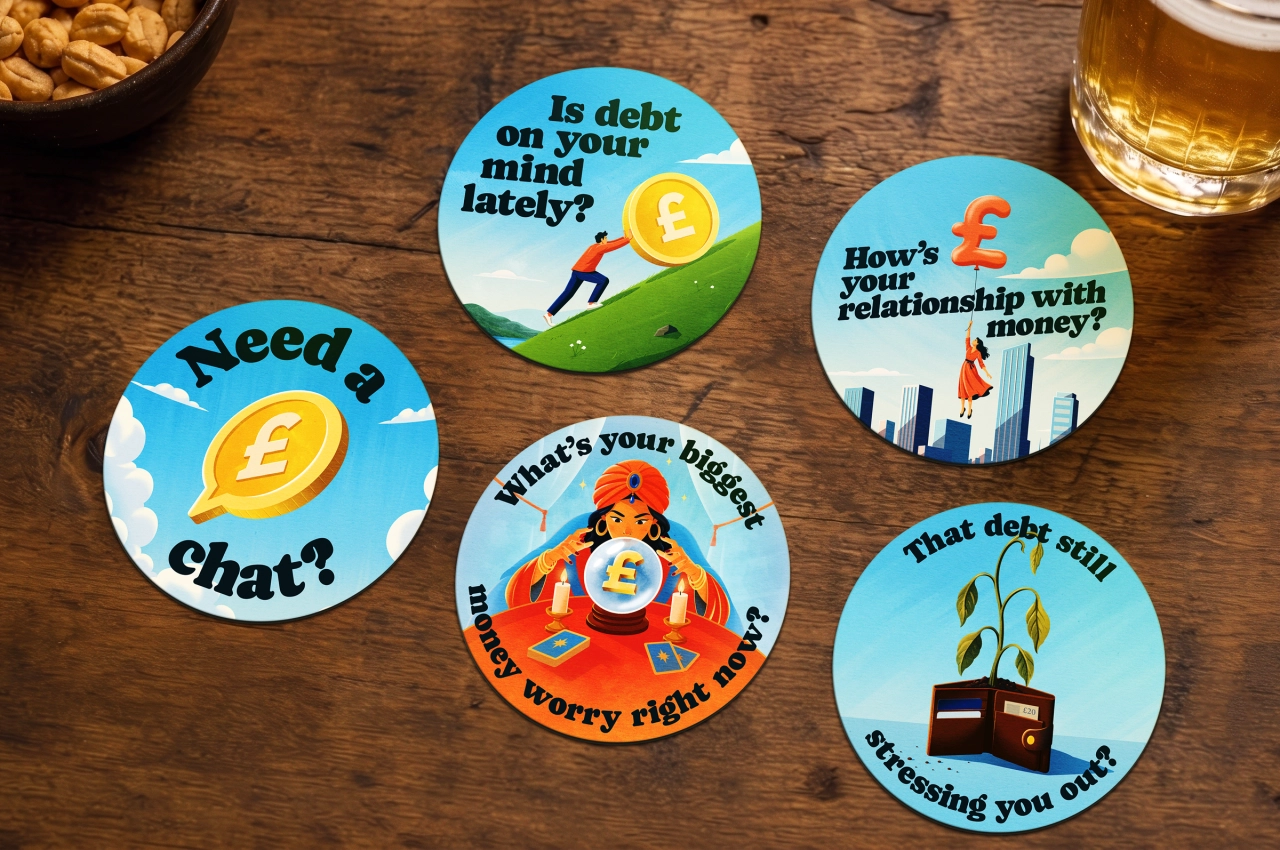
Creative Boom: Why beer mats beat billboards when you want to crack a social taboo like debt problems As part of a campaign titled 'Say It Over a Drink', 25 illustrated coasters are getting pub-goers in the UK talking about debt. Anyone who's ever worked for government, a public body or a charity will be familiar with the challenge. Your goal is to get people talking about an issue that's typically brushed under the carpet, whether that's menustration, mental health or suicide. But subjects are taboo for a reason. Stick a huge, imposing billboard in their face, and they may turn away, or tune it out.
Sometimes, then, it's better to come at things from a sideways angle. And here's a great example. Lowell calls itself Europe's leading credit management company and claims to have helped over 3.5 million customers become debt-free since its founding in 2004. But you can't help people who don't want to be helped. And most of us will know exactly what it's like when you get into seemingly unsustainable debt and feel the overwhelming urge to just bury your head in the sand. Part of that is not wanting to face up to the problem. Another important part is not wanting the social shame of admitting your problem, which leads to a horrible Catch-22.
Opening up to friends is necessary to get the emotional support you need. But the stigma of doing so keeps you trapped in a mental vicious circle. Lowell's is trying to square that circle with a campaign called Say It Over a Drink. But rather than posters, billboards or TV ads, they're doing things subtly. They've commissioned five illustrators—James Cluer, Emily Birch, Sam Peel, Ery Burns and Becky Mann—to create 25 coasters. Each carries a simple prompt designed to help someone say the first sentence about money they've been avoiding.
And they're distributing them across pubs, cafés and restaurants across the UK. Context is king So why is that a good move? I think it's all about context. A poster or billboard is normally only glanced at, so it's designed to provoke an instant, powerful reaction. "I want to buy that!" in the case of commerce. "I want to vote for/against that!" in the case of something political. But in a case like this, the instant reaction of the person in debt is just going to be that shame and embarrassment I mentioned earlier. Counterproductive, basically. A coaster, in contrast, sits on the table in a bar and largely gets ignored.
When there's a lull in the conversation, or the person you're out with heads to the loo (and there's no phone reception), you might pick it up and start playing with it, tap it against the table, subconsciously start peeling away at its corner. You probably won't even notice the words on it for a couple of minutes, if at all. When you do, though, you're probably going to be in the right mindset to take those words in. And if you're having a relaxed and pleasant night out with a friend, you're going to be more likely to actually start talking about it.
Makes sense, right? The idea originally sprang from Lowell's research among its 300 customers, of which one in four said they would rather talk to their family about sex than debt, and 69% would rather have their search history leaked than reveal their bank balance. Leaving aside how slippery those surveys can be (it all depends on how the questions are asked), that sounds about right. Maybe it's normal to talk about money in some cultures, but in England certainly "I'm a bit skint this month" or "I can't come out till payday" is about as far it'll go. In that light, these illustrations do a good job of shifting that mindset.
Article truncated for readability. Read the full piece →
The article discusses a unique approach to addressing a social taboo through an innovative campaign, making it significant and highly relevant for brand strategy professionals.