Score
Tomorrowland 2026s Stunning Designs Highlight What Creativity Can Add In A Sea Of Samey Festivals
Tomorrowland's commitment to innovative and immersive design sets it apart in a saturated festival market, demonstrating that a distinct creative identity can be a crucial competitive strategy. By investing in elaborate visual experiences that resonate emotionally with attendees, Tomorrowland not only enhances its brand but also ensures customer loyalty and early ticket sales, even as many festivals struggle to survive.
Creative Boom: News Experience Tomorrowland's stunning designs highlight what creativity can add, in a sea of samey festivals Belgium's biggest dance festival keeps building on a scale most events can't match, at a time when dozens of UK and European festivals are folding for good. Written By: Tom May 23 July 2026 If you've never heard of Tomorrowland, here's the skinny. It's one of the world's largest EDM (electronic dance music) festivals, held every summer in the small town of Boom, just outside Antwerp.
Founded in 2005 by brothers Michiel and Manu Beers, it now spans two weekends, pulls in around 400,000 from more than 200 countries, and sells out within minutes. It's spawned sister editions in Brazil and, in winter, the French Alps. This year marks its 20th edition. What sets Tomorrowland apart isn't the line-up, though that's pretty impressive, with Martin Garrix, Sebastian Ingrosso and David Guetta last weekend and Calvin Harris, Steve Angello and Steve Aoki this weekend. But what really makes it unique is the sheer scale of visual ambition poured into its design, in a way that puts most of its rivals to shame.
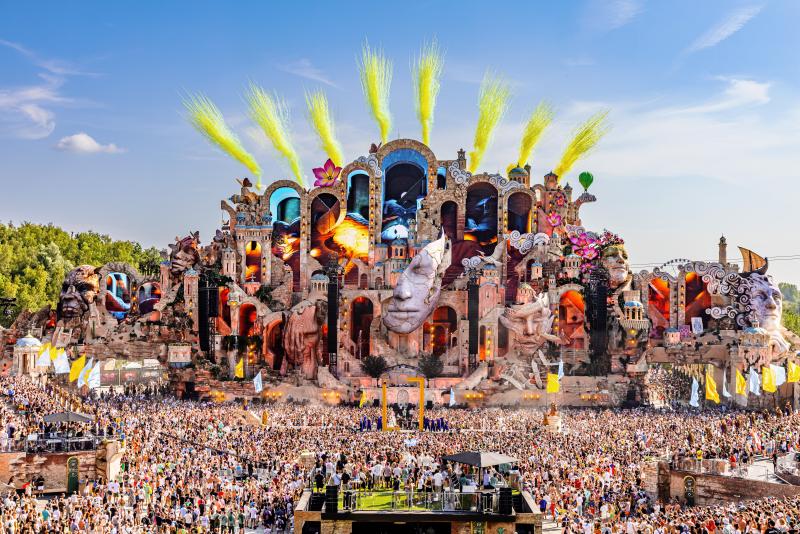
A world built around emotion Every edition of Tomorrowland is built around a theme that shapes the main stage design from the ground up. This year's theme, Consciencia, imagines a world of six provinces, each representing a different human emotion: wonder, joy, desire, love, anger and sadness. At the centre of it all sits Amutaz, a vast sculpted face intended to hold every emotion within it, with staircases and bridges radiating outward to symbolise the journey between them.
Standing 43 metres high and stretching 140 metres wide, it's built from 2,400 LED tiles, 1,200 lighting fixtures (300 of them custom-designed), 56 lasers, 38 fountains and two waterfalls, with seven giant inflatable faces looming over the crowd. The whole thing took more than two years from first sketch to opening night, followed by 54 days of on-site construction, and it will later travel to Tomorrowland's Thailand and Brazil editions. Crucially, none of this is static scenery.
The festival's longtime visual partner, the Belgian studio Prismax, builds the visuals and pyrotechnics to run live, responding to each DJ's set in real time rather than looping on a fixed cycle. Prismax has worked with Tomorrowland since its first edition over two decades ago, and last year took that same real-time tech to the Sphere in Las Vegas for UNITY, its collaboration with Insomniac, marking the first fully live visual show ever performed at that venue. It's a level of technical ambition that goes far beyond simply hanging a screen behind the DJ booth.
Commitment to spectacle That commitment to spectacle matters more than it might first appear, because the wider festival market has rarely looked shakier. In the UK alone, the last few years have seen a steady drumbeat of cancellations, several of them at frighteningly late notice. This summer, the promoter Heritage Live pulled all three of its 2026 events, including shows headlined by Janet Jackson, Christina Aguilera and Eric Clapton, blaming low ticket sales and a market that's become, in the organisers' own words, almost impossible to compete in.
Article truncated for readability. Read the full piece →
The article discusses Tomorrowland's unique approach to festival design, which is significant for brand strategy professionals looking for ways to differentiate in a crowded market, while also presenting innovative ideas that are not commonly explored in the festival industry.