Score
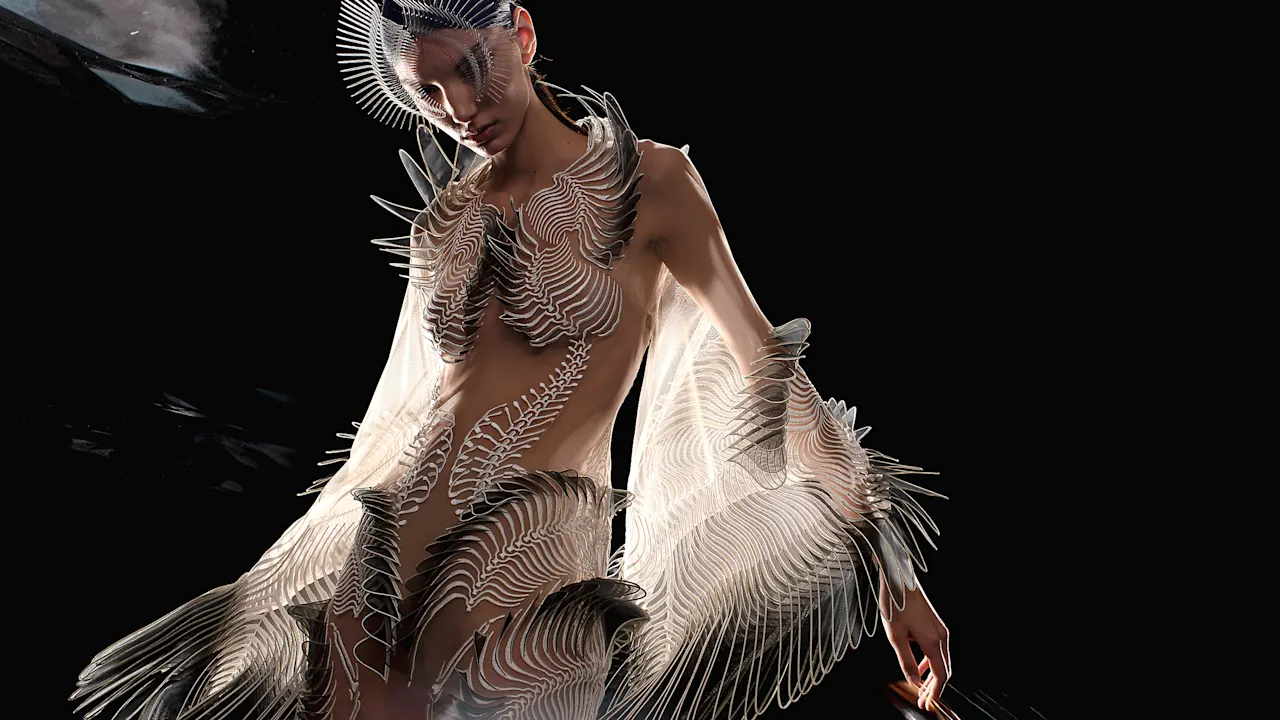
See the wild, beautiful, and almost unbelievable fashion of Iris van Herpen
Iris van Herpen's innovative approach to fashion, blending art, science, and sustainability, redefines brand strategy in the couture industry by emphasizing craftsmanship and unique design narratives. Her work not only showcases the potential of fashion as a medium for artistic expression but also highlights the importance of sustainability, positioning her brand as a leader in eco-conscious couture. This approach encourages brands to explore deeper connections with their materials and the stories they tell, ultimately enhancing their identity and market position.
FastCompany: When Olympic skier Eileen Gu walked the steps of the Metropolitan Museum of Art at the Met Gala on May 4, she wore a short, shimmering gown that appeared to be made of thousands of iridescent soap bubbles caught mid-float, clustered across her body and trailing into the air behind her. Eileen Gu at the Met Gala, 2026 [Photo: Getty] It was created by Iris van Herpen in collaboration with the Tokyo-London design studio A.A.Murakami. Assembled from 15,000 hand-formed glass bubbles, it took 2,550 hours to construct, and contained hidden microprocessors that released real bubbles into the air as Gu moved.
It was also a glimpse into the show that opens at the Brooklyn Museum on May 16: Iris van Herpen: Sculpting the Senses , the North American debut of a retrospective that has already traveled from Paris to Brisbane, Australia, then Singapore and the Netherlands. The 2016 original of that bubble dress will be in the show. “It represents the air that’s inside of our bodies,” says Matthew Yokobosky, the Brooklyn Museum’s senior curator of fashion and material culture. “Over 90% of our bodies are made up of air.” Over two decades, van Herpen has built a body of work that treats science as a creative collaborator.
She has made couture inspired by the air in our lungs, the architecture of a stingray’s skeleton, the magnetic fields of the Large Hadron Collider. She has worked with architects, paleontologists, and biologists, and used everything from iron filings to magnets to bioluminescent algae as raw materials. In doing so, she has quietly redefined what it means for fashion to be art. The Brooklyn Museum has been making that argument for nearly a century.
Its 1934 Story of Silk exhibition is often cited as the beginning of fashion’s museum era; it has since staged retrospectives of work by Madame Grès, Schiaparelli, Jean Paul Gaultier, Pierre Cardin, Christian Dior, Virgil Abloh, and Thierry Mugler. Sculpting the Senses extends the lineage. [Photo: Brooklyn Museum] Water in all its forms The bubble dress is a launchpad for the exhibit. “The show starts about different inspirations from the different forms of water, liquid, frozen, gaseous, and how all those different states have been equally informative for her as a design inspiration,” Yokobosky explains.
It is paired with a piece by the Japanese art collective Mé, a work that Yokobosky says “looks as if they had taken a slice of the ocean and put it into the gallery.” Van Herpen, who grew up in the Dutch village of Wamel, has returned again and again to water in all its states. That preoccupation goes back to the work that put her on the map. Her 2010 Crystallization collection, built around limestone deposits, ice crystals, and the choreography of a splash, contained the first 3D-printed garment ever shown on a fashion runway.
The skeletal, ivory-colored top made in collaboration with British architect Daniel Widrig, is on display in Brooklyn. Depending on the angle, the piece looks like a fossilized vertebra or a Dutch ruff from the 17th century. Materialise, the Belgian 3D-printing firm that helped fabricate it, had until then been making architectural models. Bones, fossils, and a baby dinosaur [Photo: Brooklyn Museum] Since the natural history specimens in the Paris version of van Herpen’s show couldn’t travel, Yokobosky struck up a new partnership with the American Museum of Natural History.
Article truncated for readability. Read the full piece →
Iris van Herpen's innovative blend of art, science, and sustainability in fashion presents significant implications for brand strategy professionals, showcasing a unique approach that is both impactful and relevant to current industry trends.