Score
Adobe is rolling out agents for its Creative Cloud apps. It will be a lifesaver for creatives
Adobe's rollout of AI agents for its Creative Cloud applications marks a significant shift in brand strategy, emphasizing the enhancement of creative workflows by automating tedious tasks. This innovation not only aims to improve efficiency for professionals but also positions Adobe as a leader in integrating AI into creative processes, allowing users to focus on the artistic aspects of their work.
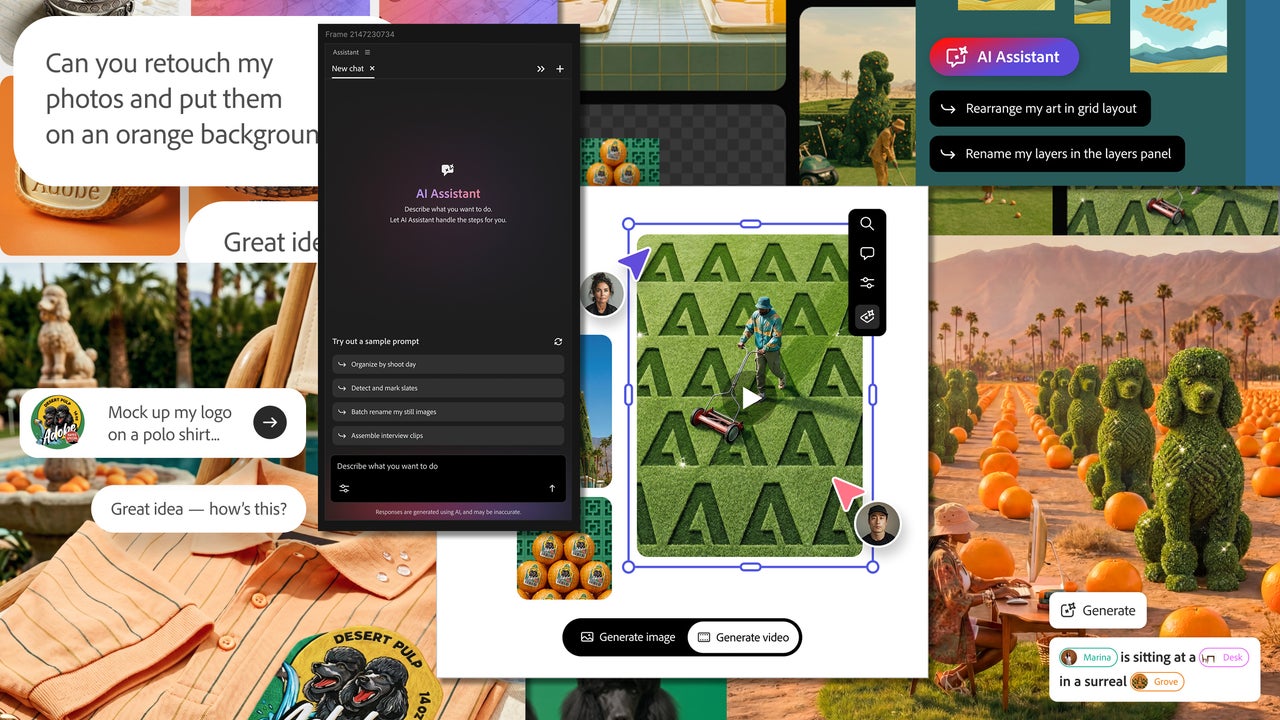
FastCompany: I’m not a fan of AI used for actual creative work, but the new agents for Photoshop, Illustrator, InDesign, and Premiere are a completely new twist to Adobe’s approach to AI. And it’s that every creative person can get behind because it is truly focused on fully automating the most tedious tasks of their work. I found myself in awe as I watched someone using an agent to set up a Premiere project. It did everything starting from a pile of randomly named video, audio, and graphic files to creating a project structure.
I watched as it renamed and tagged footage using computer vision to entirely setting up a cut for a video interview, synchronized footage from multiple cameras, and put everything in the right place in the editing timeline. What felt like an infinite number of hours wasted in doing basic chores will be gone forever with agents. That’s the entire premise of this new update, and then some. That video work magic is just one piece of a broader rollout bringing an AI Assistant to Adobe’s flagship creative suite.
The company just launched these tools in a public testing phase for its core stable—Premiere Pro, Photoshop, Illustrator, InDesign, and Frame.io—while keeping the After Effects iteration under wraps in a private beta. This fundamentally changes the daily reality of creative work, which has been bogged down by endless clicking of nested menus and palettes. With Adobe’s version of agents, the creator remains in charge. The point isn’t to replace the human element, but rather to eliminate the mechanical chores that drain energy before the actual artistic process even begins.
By offloading the friction of batch processing or layer management to a background process, the assistant clears the deck. [Image: Adobe] The three altitudes of AI “There’s this kind of transformation occurring with AI in the workforce,” says Forest Key, Adobe’s vice president of Agentic AI and Firefly. He notes that this evolution maps out across three distinct altitudes. The first is using the technology strictly as an assistant to remove drudgery and accelerate mundane functions. The second phase is co-working, where the software acts as a thought partner, while the professional constantly inserts their taste and editorial voice.
The third level relies on setting up agents that execute full, parallel automations while the human only periodically checks in on the loop. This current release is fundamentally focused on mastering that first altitude. The breakthrough powering this first phase is how the software interprets human instruction, Key explains. He points out that creators possess a vast, highly specific vocabulary for shape, color, mood, and emotion.
By typing those specific intentions into a prompt box, Key says, “the system is able to take those words and translate it into complicated mechanical gestures inside of the product.” The agents operate by taking control of the software’s native tools just as a human user would. In the case of that Premiere demo, it doesn’t spit out a flattened, finished video from raw footage. It manipulates the folder structure, the files themselves, the timeline, keyframes, and layers directly, leaving behind a fully editable project file ready for actual creative work.
Article truncated for readability. Read the full piece →
The introduction of AI agents in Adobe's Creative Cloud represents a significant advancement in creative workflows, making it highly impactful and relevant for brand strategy professionals, while also being a novel approach in the design industry.
Weekly digest
Get the Signal digest
Every Monday morning — the top 3 brand trends, 10 high-signal articles, and one emerging signal to watch.
No spam. Unsubscribe anytime.