Score
Walmart’s largest private label rebrands—and goes full ‘shoppy shop’
Walmart's rebranding of its Great Value private label aims to elevate consumer perception by enhancing packaging design to reflect quality rather than just low prices. This strategic shift is intended to attract higher-income shoppers and position Great Value as a competitive alternative to premium national brands, ultimately aligning the brand's visual identity with its product quality.
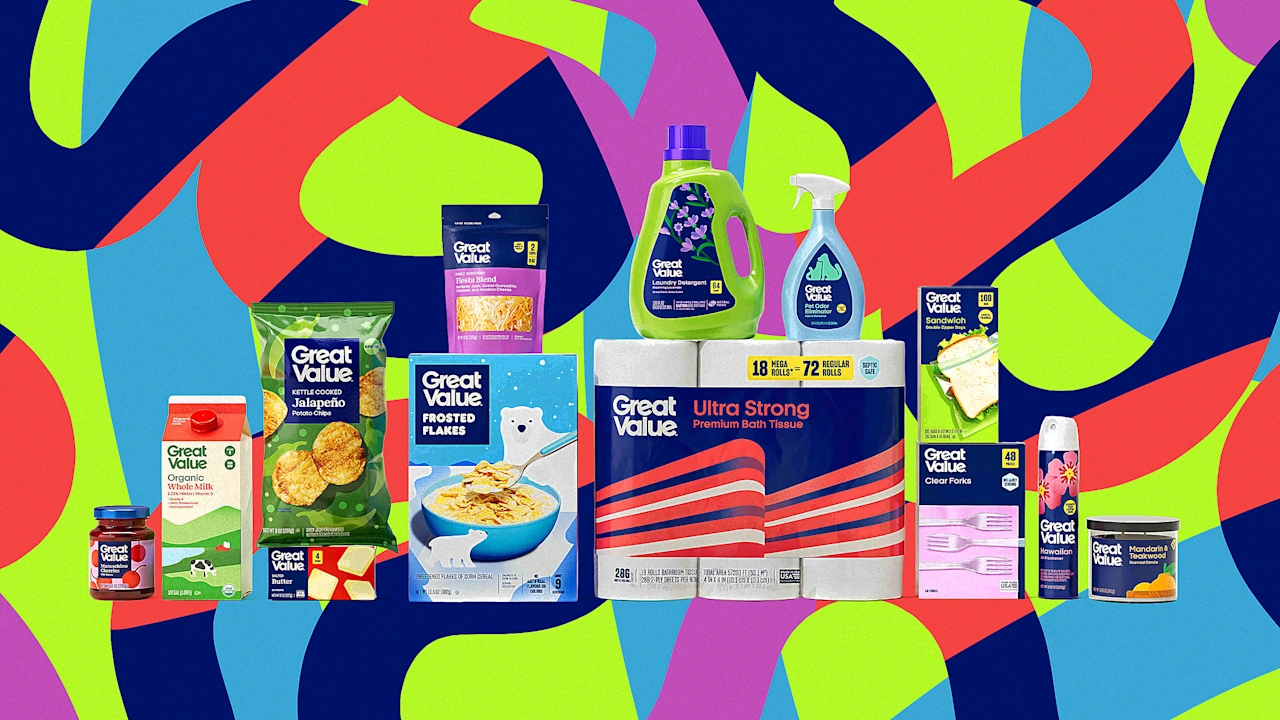
FastCompany: There’s a good chance you have a Great Value product in your home right now: perhaps chicken nuggets in the freezer, or paper towels on your counter. The brand (Walmart’s largest private label, which launched in 1993) turns up in 9 out of 10 American households. By Nielsen’s count, that makes it the largest consumer packaged goods brand in the United States—bigger than Coca-Cola and Pampers. Until now, Great Value’s packaging has been designed to telegraph low prices: Walmart estimates that these products save the average family more than 35% annually compared to national brand equivalents .
Its white background, blocky letters, and straightforward blue logo were meant to signal a no-frills brand with products that are good for your wallet. [Photo: Walmart] But in focus groups, Walmart customers expressed that while they appreciate how much money they save , they’re not necessarily proud to have the products out when company comes over. “They want to be proud to buy Great Value,” says Scott Morris, SVP of private brands, food, consumables, and manufacturing at Walmart U.S. “They want to be proud to have it in their home, to share it with their friends and family.” Walmart has heard its customers.
Today, the biggest retailer in America announces a comprehensive redesign of Great Value, the first full refresh of the brand in more than a decade. It’s a big task, involving the overhaul of nearly 10,000 food and consumable items across more than 100 categories, that will take place over the next 18 months. [Photo: Walmart] The rise of the “shoppy shop” dupe The timing of the rebrand is apt. Inflation has pushed grocery prices up across the board over the past few years, and consumers who might once have defaulted to Whole Foods or a specialty grocer started filling their carts at Walmart, often for the first time.
On the company’s February earnings call, Walmart CFO John David Rainey noted that shoppers earning more than $100,000 a year were among the biggest contributors to growth in the quarter—due to those broad economic headwinds, and to the big-box retailer’s strategic response: a deliberate effort to attract those higher-income shoppers over the past five years . Walmart’s Great Value rebrand is part of a broader effort among retailers to make their private labels as compelling to customers as the premium national brands that sit on their shelves.
Given how crowded the consumer packaged goods industry is, upscale direct-to-consumer food startups like Brightland , Fishwife , Fly by Jing , and Ghia have historically broken through online with highly branded packaging. Those brands soon landed in small, curated, upscale boutiques (so-called shoppy shops ) before securing deals with big retailers like Whole Foods, Target, and, yes, Walmart. This has influenced how the larger retailers like Walmart have designed the branding and packaging of their private-label brands, by presenting them as an affordable alternative with the same quality and shelf appeal.
In 2019 Target launched Good and Gather, a food brand that stands out for its approachable, color-on-color premium branding. And discount grocery chain Aldi modernized its own private-label food products last fall. Meanwhile, Walmart has been quietly reshaping its private-label portfolio for years. It launched a premium food line called Bettergoods in 2024 that focuses on global flavors and better ingredients, with the kind of colorful, illustration-forward branding familiar to modern consumers who might also buy upscale DTC products.
Article truncated for readability. Read the full piece →
Walmart's significant rebranding of its private label has the potential to reshape consumer perceptions and market dynamics, making it highly impactful and relevant for brand strategy professionals, while the approach of enhancing packaging design is somewhat novel but not entirely unprecedented.
Weekly digest
Get the Signal digest
Every Monday morning — the top 3 brand trends, 10 high-signal articles, and one emerging signal to watch.
No spam. Unsubscribe anytime.