Score
Why Did The New Yorker Join Substack
The New Yorker’s decision to join Substack highlights a strategic shift towards leveraging social platforms for deeper engagement with readers. By treating Substack as a community-building tool rather than just a newsletter service, The New Yorker aims to foster direct relationships between writers and readers, enhancing its brand presence in a competitive digital landscape.
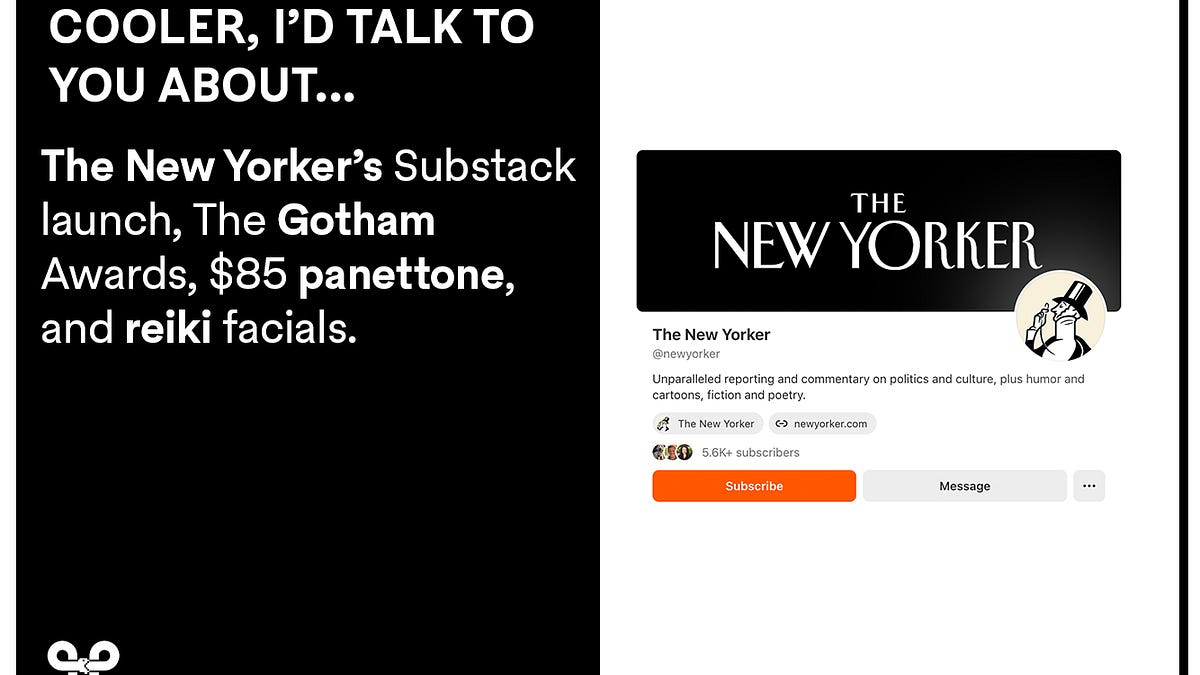
Feed Me: Why did The New Yorker join Substack? "We’re approaching Substack as much as a social platform as a newsletter-delivery system." Good morning everyone. Me and Rachel Karten’s 150-person holiday party filled up in three minutes yesterday. The waitlist currently has 600 people on it. If anyone here works at MSG, maybe we can do the next one there. Speaking of big events, I’ll be at DealBook later today.
Hopefully I’ll see some of you there. Today’s letter includes: Why The New Yorker joined Substack, Chanel’s subway fashion show, Cami Fateh attended The Gothams, a reiki facial, and thinking about what charli xcx wrote about liminal spaces. Feed Me is a daily newsletter about business and culture. It’s $80/year, or about $6.50/month. The New Yorker’s Executive Director of Communications emailed me on Monday night to let me know that the magazine would be launching on Substack. They join fellow Condé Nast publications Allure magazine and Bon Appétit, which have been publishing on Substack for some time now.
The format — “We’re thinking of this space as a book club, but for magazine articles.” — is smarter than many of the other launches I’ve seen on here, and actually leans into Substack’s unique features: comments, chat, a relationship between writer and reader. Last week, Puck’s Julia Alexander wrote an in-depth piece about legacy publications like The Economist and New York Magazine experimenting with the distribution benefits of Substack.
Puck would probably do pretty well on here — they have super voice-y writers who have varying degrees of cult-level readership, which I have found to be one of the prerequisites to success on this platform. I had two questions for Jessanne Collins, The New Yorker’s Director of Newsletters:Emily: Why now?Jessanne: “We’re launching now because, like every publisher, we’re constantly thinking about how to reach readers where they are and how to form direct, ongoing relationships with them. At this stage, we’re approaching Substack as much as a social platform as a newsletter-delivery system.
(We already have a very robust newsletter program—more than two million people subscribe to our flagship daily.) Substack is where thoughtful conversations are unfolding and engaged communities are taking shape. We think there’s a real opportunity here to not just bring more New Yorker journalism into that ecosystem, but to cultivate a community of readers around it, and to help them connect—both with our writers, many of whom are already on the platform, and with one another.”Emily: How many renditions of this newsletter did you consider?
Or did you always think you’d launch with this format? The New Yorker’s Executive Director of Communications emailed me on Monday night to let me know that the magazine would be launching on Substack. They join fellow Condé Nast publications Allure magazine and Bon Appétit, which have been publishing on Substack for some time now.
Article truncated for readability. Read the full piece →
The New Yorker's strategic shift to Substack represents a significant trend in media engagement, making it impactful and relevant, though not entirely novel as other publications have explored similar platforms.
Weekly digest
Get the Signal digest
Every Monday morning — the top 3 brand trends, 10 high-signal articles, and one emerging signal to watch.
No spam. Unsubscribe anytime.