Score
You can finally buy an Eames house. Sort of
The collaboration between the Eames Office and Kettal to produce modular pavilions represents a significant evolution in brand strategy, merging iconic design with modern manufacturing to address contemporary housing challenges. This initiative not only revitalizes the Eames legacy but also positions both brands as innovative leaders in sustainable architecture and adaptable living solutions, appealing to a market increasingly focused on ecological and efficient housing options.
FastCompany: In a 1944 issue of Arts & Architecture magazine, the architect and designer Charles Eames sounded an alarm. “It has been estimated that one million five hundred thousand houses each year for a period of 10 years will be needed to relieve the urgent housing problem of this country,” he wrote. “The enormity of such a need cannot even be partially satisfied by building techniques as we have known and used them in the past.
Large scale industry would seem to be the only logical means by which we can achieve an enterprise of such proportion.” Throughout their careers, Charles and Ray Eames explored how industrial production could impact home building, most famously through their own Pacific Palisades residence , also known as Case Study #8. But a fully factory built house was their elusive white whale. Now it’s finally becoming a reality through a collaboration between the Eames Office , a non-profit organization dedicated to stewarding and extending the couple’s work, and Kettal , a Spanish manufacturer of furniture and prefabricated pavilions.
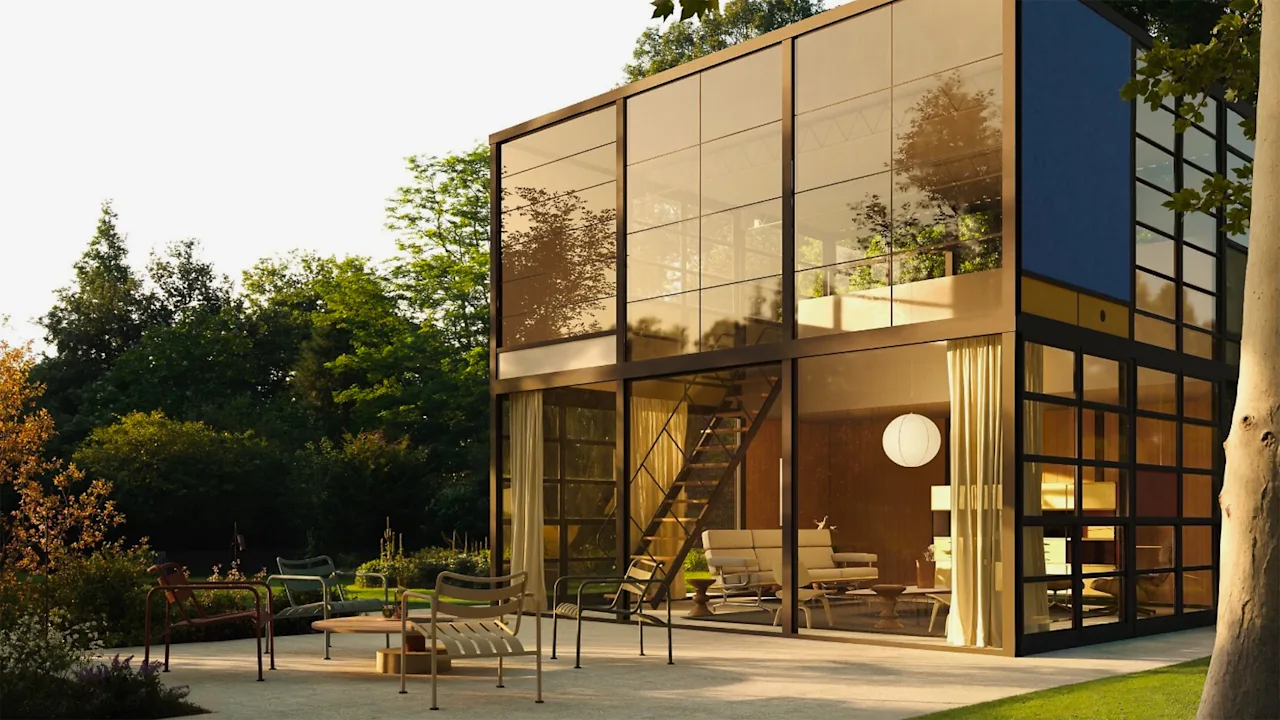
At Milan Design Week, the two organizations are debuting The Eames Pavilions, a modular construction system based on the designers’ philosophy of efficient, flexible, and adaptable architecture. A four meter square indoor pavilion, which is roughly 170 square feet, will start at 45,000 Euros (about $52,000) and is expected to go on sale worldwide in late 2026. An outdoor version of the same size starts at 60,000 Euros (about $69,000) with an estimated availability in 2027. Customers can combine modules to create larger pavilions and it’s possible to stack them to two stories, too.
[Image: Eames Office] For the Milan installation, on view at the Triennale Museum from April 21 to May 10, 2026, Kettal and the Eames Office will show two of the myriad configurations that the system can produce. The first is a double-height iteration, which looks a lot like the Case Study #8. It has a black-painted metal frame, floor-to-ceiling glass walls, zig-zag trusses, chicken wire–reinforced windows, and vivid wall panels in primary colors. (The price tag for this specific build? $145,000 Euros, or about $167,000.) The second is a single module featuring wall panels adorned with geometric shapes the Eameses liked.
While not a one-to-one replica of any previous Eames house, the kit of parts represents an amalgamation of the designers’ core ideas around materiality, structure, and proportion and, importantly, channels the captivating spirit of their residential projects. “The Eames house and their other houses, were meant to be the beginning of something that would turn into a system or into a series, but they were experiments,” says Eckart Maise, author of the forthcoming book The Eames Houses and a design consultant who worked closely on the product’s development.
“Charles and Ray were very clear in their intent to mass produce.” The housing crisis is even worse now than when Charles wrote his Arts & Architecture article. According to Zillow , the housing deficit has grown to 4.7 million units in 2025. Could an Eames prefab offer a solution? [Image: Eames Office] A long road to mass production The Eames Office has been exploring an answer to this question for years.
Article truncated for readability. Read the full piece →
The collaboration between the Eames Office and Kettal represents a significant shift in brand strategy by merging iconic design with modern needs, making it highly impactful and relevant for brand strategy professionals, while also introducing a novel approach to sustainable living.
Weekly digest
Get the Signal digest
Every Monday morning — the top 3 brand trends, 10 high-signal articles, and one emerging signal to watch.
No spam. Unsubscribe anytime.