Score
Should We Do It At All The Question David Johnston Wants Every Creative To Ask Before The Brief Goes Out
David Johnston's new framework, Signalism, encourages creatives to question the necessity of their projects before proceeding, emphasizing the importance of understanding the impact of their designs on the future. This approach shifts the focus from merely creating desire to considering the ethical implications and desired outcomes of design work, urging brands to define the behavior they want to promote before executing their strategies.
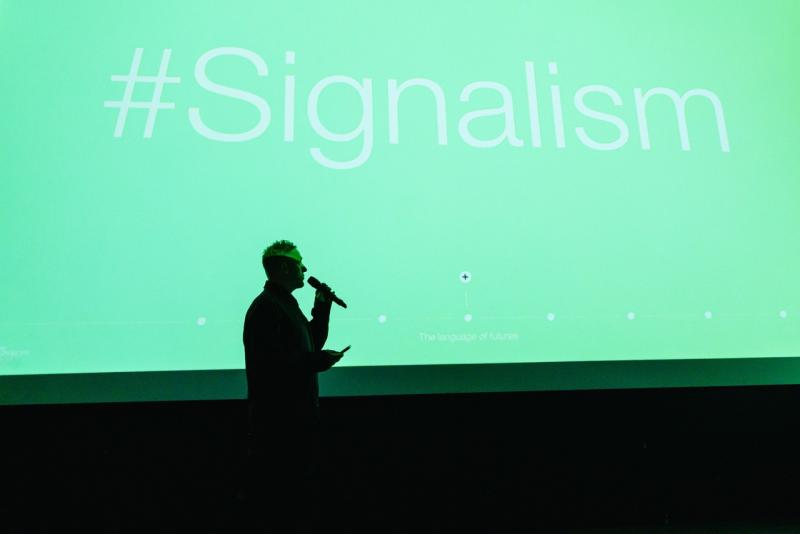
Creative Boom: Insight Creative Industry 'Should we do it at all?' The question David Johnston wants every creative to ask before the brief goes out Accept & Proceed's founder spent 20 years mastering the mechanics of desire. Now his new framework, Signalism, asks what that mastery actually costs. Written By: Tom May 1 July 2026 All images by Angela Grabowska At the start of a project, all good creatives ask the same questions. Can we build it? Will people want it? Can it scale? David Johnston, founder of Accept & Proceed, has spent two decades answering all three, first at Nike, then across nearly 20 years running his own studio.
What he's increasingly preoccupied with now is the question nobody trains you to ask: should we do it at all? That question sits at the centre of Signalism, the framework and forthcoming book David has been developing and testing on stages from Athens to Birmingham. It argues that signals shape behaviour, that behaviour shapes belief, and that belief shapes the futures we end up living in. And it describes a chain that runs from bioluminescent bacteria 3.8 billion years ago, right through to modern brand campaigns and AI feeds. It's a big, strange, ambitious idea.
But talk to David for any length of time, and it becomes clear the project isn't really about branding theory. It's about a feeling he's noticed in himself, in his studio, and in students at design schools across the country. I asked him where he thinks that feeling comes from and what creatives should actually do about it. The dark inheritance of "brand" David begins by explaining that there was no single lightbulb moment for all of this. "It was more a gradual realisation," he says. "In my work, in conversations I was having, and in what I was seeing in the wider world." He loved learning how to create desire in people and spread stories.
Yet discomfort crept in once he noticed those same mechanics operating everywhere else: "underneath politics, conspiracy theories, financial markets, culture wars and algorithmic feeds". It's not that persuasion itself is new or wrong, though. "Persuasion has always existed," he reasons. "It's simply recognising that if persuasion is infrastructure, then responsibility enters the room." That thought sent him digging into etymology—the study of the origin of words—with unsettling results. He realised the word "brand" has its roots in fire: in marking ownership on cattle and, at times, on people.
"That's a surprisingly dark inheritance for a discipline so often associated with creativity, culture and possibility, isn't it?" he observes. "Nobody teaches you that at design school." He's not arguing for abandoning brand as a tool. But he does suspect the language itself has simply become too small for what the work needs to do next, and that expanding the vocabulary might expand the imagination too. It's a concern he hears from students constantly. "They love creativity," he reflects. "They love making things.
But many are genuinely concerned that they might spend their careers contributing to systems that are harmful, extractive or simply making the world worse." Signalism, he says, "emerged, in part, as an attempt to give language to that feeling". A 3.8-billion year topic Signalism's timeline begins long before humans, with bioluminescent bacteria and cyanobacteria. David is deliberate about that scale. "3.8 billion years changes the conversation, doesn't it?
Article truncated for readability. Read the full piece →
David Johnston's framework introduces a significant ethical consideration in the design process, making it highly relevant and impactful for brand strategy professionals, while also presenting a novel approach to project initiation.
Weekly digest
Get the Signal digest
Every Monday morning — the top 3 brand trends, 10 high-signal articles, and one emerging signal to watch.
No spam. Unsubscribe anytime.