Score
This viral vibe-coded game turns Google Maps into a time machine
WenWare, a viral game inspired by GeoGuessr, utilizes AI to create immersive historical panoramas that players navigate to guess locations and timelines. This innovative approach highlights the potential for brands to leverage generative AI and interactive experiences in their strategies, appealing to users' curiosity and engagement with history.
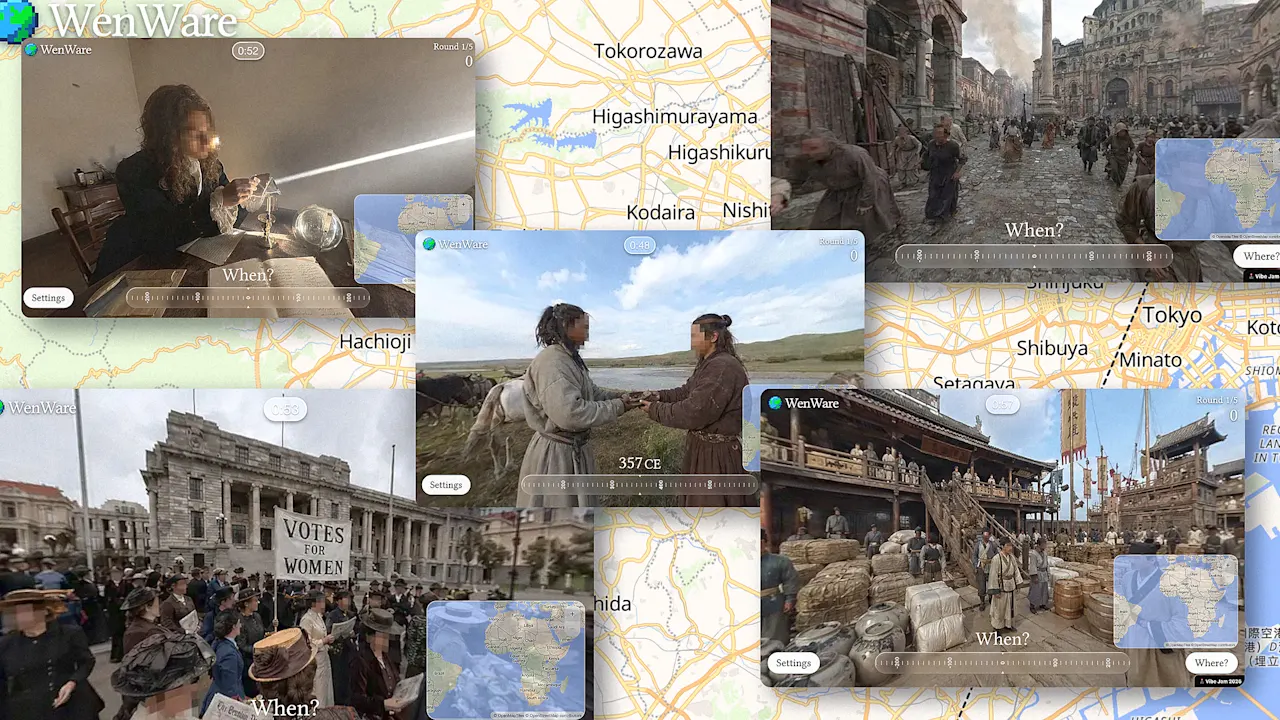
FastCompany: You are on a street. You see stone buildings, gas lamps, some men in long coats. Is this somewhere in Europe? Probably. But, when ? That is the question that WenWare adds to the formula of GeoGuessr, a popular game that shows Google Maps locations all over the Earth and asks players to guess where it is. The free browser-based WenWare drops you inside an AI -generated historical panorama, completely navigable in virtual reality, and gives you 60 seconds to do two things: pinpoint the location on a world map and adjust a timeline slider to the correct year. The person behind the project goes by @underpaid_mom on X.
With no real name, no company, the game was created as a submission for vibejam 2026 , an AI-based browser game development competition, and appeared on the internet in late April 2026 with the description “a time-traveling GeoGuessr-inspired game where you can explore immersive 360-degree historical scenes.” [Screenshot: WenWare] The game became an instant viral hit . Each game session offers five chances to pinpoint the spacetime coordinates of five different scenes, moments like the Wright brothers’ first flight, the coronation of Charlemagne, or the creation of Leonardo da Vinci’s The Last Supper.
You look around and analyze the scene like a detective: the silhouette of a vehicle, the cut of a uniform, the shape of a roof, a flag that rings a bell but you can’t really place. Then you submit your two answers. First, the year, using a slider. Then, the place on a Google Maps map, overlaid in the lower right corner of the screen. The game scores them simultaneously, showing you how close you are to both on a map, with a card on the right top corner that explains to you what you just saw.
Each time, the scores will be added to a total, which may get you into the Top 100 global leaderboard in each category: modern, medieval, ancient, or, the hardest of all, any of the three ages. [Screenshots: WenWare] Generative AI and vibe coding WenWare was built with three artificial intelligence tools. The first is GPT-Image-2 , OpenAI’s image generation model. You know the drill: From a prompt, it produces a photorealistic image. But, in this case, not just any image.
WenWare needs images that capture a full 360-degree view of a scene, so GPT-Image-2 was used to generate what is called an equirectangular image, a photo shot from all directions at once—up, down, left, right, behind—then stretched out onto a flat surface. As a flat file, the image looks distorted and strange. That’s where Three.js comes in. Three.js is a JavaScript library—a set of pre-programmed tools that run directly in any web browser—used to take that flat 360-degree image and line the inside of a virtual sphere with it.
You, as the viewer, are placed in the center, like an onlooker transported to single 3D coordinate in time and space. Wherever you move your mouse, your gaze follows, the image filling your field of vision. The illusion of being inside a real place materializes instantly, in the Petrograd of 1917 or wherever the AI has dropped you. [Screenshots: WenWare] The third tool is OpenAI Codex , an artificial intelligence system that generates functional computer code from natural language prompts.
Article truncated for readability. Read the full piece →
The article discusses a unique application of AI in creating engaging experiences, which has significant implications for brand strategy and user engagement, making it both impactful and relevant for professionals in the industry.