Score
Google redesigns Gemini AI to break down the ‘giant wall of text’
Google's redesign of its Gemini AI assistant marks a significant shift in user interface strategy, moving away from traditional text-based interactions to a more dynamic, multimodal approach that adapts to user needs. This transformation aims to enhance user experience by providing tailored responses through varied content formats, potentially setting a new standard for AI interfaces and influencing how users engage with AI technology.
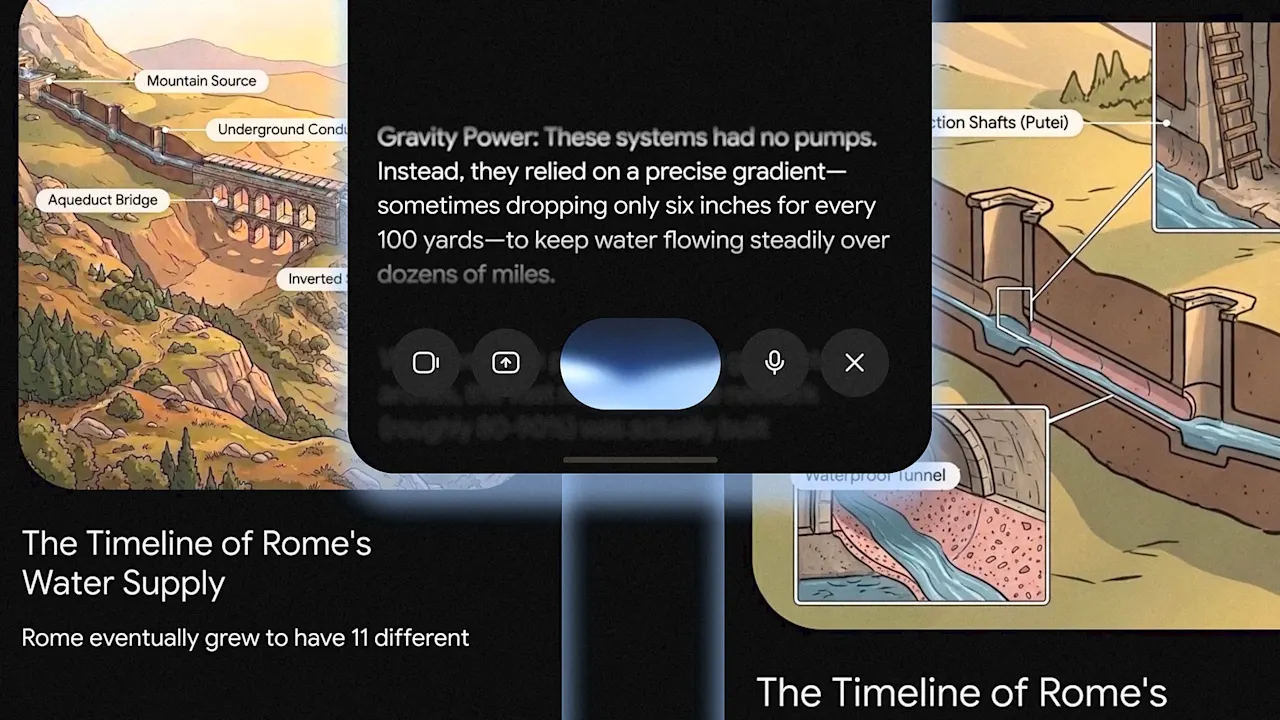
FastCompany: The chat log era of artificial intelligence is coming to an end. Google has just released a new version of its AI assistant, Gemini , that radically rethinks the prompt-and-response interface that has been a mainstay of the first few years of widely available generative AI. Instead of users typing in questions or prompts and getting back detailed written answers—”the giant wall of text,” as Gemini’s UI/UX lead Jenny Blackburn puts it—Gemini will now respond with a wider variety of content, from rich visuals to interactive elements to magazine-like graphic layouts.
Depending on the prompt or query, Gemini will organically respond with the most appropriate level of detail in the display format that makes the most contextual sense. [Image: Google] “It stops feeling like you’re scrolling through this endless chat log and more like the interface is organically adapting around the information that’s being generated,” says Blackburn. Announced at Google’s annual developer conference, Google I/O , the redesign of Gemini is a major shakeup of the user interface of mass market AI. With an estimated 900 million monthly users, Gemini is one of the main ways most people interact with AI firsthand.
Until now, those interactions have been limited by the parameters of the chat format, a sometimes clunky conversation that can require asking and re-asking a question to get an AI to return a useful nugget of non-hallucinated information . The new Gemini app and desktop experience was designed around adaptability, with more intuitive controls and features, more ways of injecting information or collateral detail into a prompt, and more nimble responses. [Image: Google] “We think that as this technology becomes more capable, the interface should actually get simpler,” Blackburn says.
“Instead of you as a user having to learn and adapt to the software, which has been how software has been forever, we really see a future where the software adapts to the user and takes into account their specific needs.” Blackburn and her team drew on a depth of user data and feedback to guide their interventions. One prominent request from users was to be able to toggle more easily between input modes, switching from typing a query to speaking to uploading documents or reference images. “Multimodality matters a lot,” says Blackburn. “We see, particularly on phones, people use their camera a lot to give context to Gemini.
They also really like to switch between voice and typing. And they were telling us you need to make this easier.” The redesigned Gemini streamlines the typing interface by displaying only the text box and the keyboard during written prompting, and has a separate menu with a simple grid of icons to choose other forms of input. [Image: Google] Blackburn says the redesign of Gemini was a chance to reframe the AI experience, offering not just a superficial gloss but a more thoughtful design scaffold undergirding the entire process of prompting and receiving a response.
She and her team developed a visual concept for the new Gemini that references the atomic-level movement of energy, and simple interconnected units that work together as a system. “This is a subtle nod to what’s happening behind the glass. And it’s intended to capture the fluid momentum of the model as it’s processing data,” she says. They named the resulting design language Neural Expressive. “We wanted to create the feeling of seeing neurons fire,” she says.
Article truncated for readability. Read the full piece →
The redesign of Gemini AI represents a significant advancement in user interface design for AI, which is highly impactful for the brand and design industry, while also being relevant and actionable for brand strategy professionals.
Weekly digest
Get the Signal digest
Every Monday morning — the top 3 brand trends, 10 high-signal articles, and one emerging signal to watch.
No spam. Unsubscribe anytime.