Score
This futuristic student village is now Europe’s largest 3D-printed housing development
The Skovsporet development in Denmark represents a significant advancement in 3D-printed housing, showcasing the potential for sustainable and community-oriented living spaces. This project not only highlights the capabilities of 3D printing at scale but also emphasizes the importance of integrating modern technology with traditional housing needs, which could reshape future brand strategies in the construction and housing sectors.
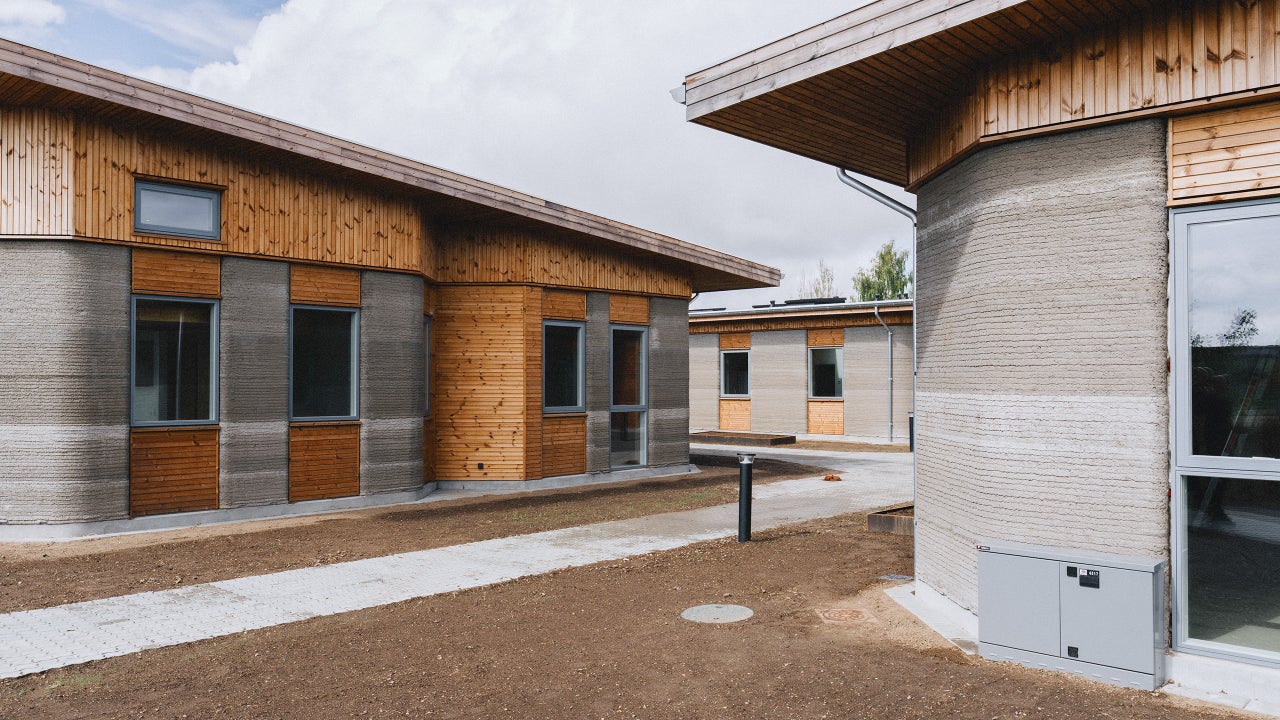
FastCompany: New student housing near VIA University College in Denmark is now the largest 3D-printed housing project in Europe—and it shows the possibilities of 3D-printed housing when it’s built at scale. [Photo: SAGA Space Architects] Called Skovsporet, the development is a 36-unit complex spread across six buildings on an area of 17,760 square feet in Holstebro, a town on the west side of the Jutland peninsula. Each low-rise unit is made from a low-carbon concrete that was 3D-printed on site. Each of the private apartments was designed as a complete home, with a sleeping area, bathroom, lounge, kitchen, and study area.
Large windows and a slanted timber hybrid roof allow in natural light, and cork panels and glass give it texture in addition to the 3D-printed walls. Each apartment was built around shared courtyards connected by walking paths and garden landscapes. [Photo: SAGA Space Architects] [Photo: SAGA Space Architects] The previous largest 3D-printed housing project in Europe was ViliaSprint , a three-story, 12-unit complex completed this spring in Reims, France. Germany built its first 3D-printed public housing in the city of Lünen in 2023. Saga Space Architects and MS+ designed the Skovsporet complex with the contractor, 3DCP Group.
The brief for the project wasn’t demonstrative or experimental. Its intention was to be permanent social housing delivered within the same regulated framework as conventional social housing in Denmark, according to Sebastian Aristotelis, lead architect at Saga, and Mikkel Brich, CEO of 3DCP. The goal of designing private apartments with communal spaces was to support both independent living and community, and the architects looked for how they could deliver on that goal with 3D-printed structures built within Denmark’s strict regulations for subsidized housing.
[Photo: SAGA Space Architects] [Photo: SAGA Space Architects] “We hope the students feel that they are living in one of the coolest futuristic student villages out there, while it still feels like home,” Aristotelis and Brich tell Fast Company in an email.
“We also wanted Skovsporet to create a strong sense of community, which is why the homes are arranged around shared outdoor spaces and within proximity of various educational institutions.” “The real potential of 3D printing becomes apparent when the technology moves beyond prototypes and one-off landmark projects and begins to compete with conventional construction in everyday housing,” Aristotelis and Brich say. Once the production setup was established, working at scale strengthened the advantages of 3D printing since repetition created opportunities to refine and optimize the process from one building to the next.
[Photo: SAGA Space Architects] A mixture called D.fab was added to the concrete, allowing an 84% reduction in carbon dioxide emissions compared with traditional concrete. The complex was built between existing trees so 90% of them could be preserved during construction.
Article truncated for readability. Read the full piece →
The article discusses a groundbreaking 3D-printed housing development that could influence future brand strategies in the construction sector, making it significant and novel, though its direct relevance to brand strategy professionals may vary.