Score
CORNCRETL: Robotic 3D Printed Construction from Corn Waste
The development of CORNCRETL by MANUFACTURA represents a significant advancement in sustainable construction, leveraging corn waste to create a low-carbon, efficient building material. This innovative approach not only addresses environmental concerns but also revitalizes traditional building techniques, suggesting that brands in the construction sector should prioritize sustainability and material efficiency in their strategies.
Abduzeedo: CORNCRETL: Robotic 3D Printed Construction from Corn Waste kai April 04, 2026 CORNCRETL by MANUFACTURA blends corn waste and lime aggregates into a mix for robotic 3D printed construction that reduces carbon emissions by up to 70%. Mexico-based design practice MANUFACTURA developed CORNCRETL as a response to one of the construction industry's core problems: high carbon output and low material efficiency. The material combines corn residues, recycled nejayote — the calcium-rich wastewater from corn nixtamalization — and lime-based mineral aggregates into a printable composite for robotic 3D printed construction workflows.
The research draws from pre-Hispanic building traditions. In Mayan culture, lime mixtures known as Sak-Kaab provided breathable, self-healing wall systems that required lower calcination temperatures than Portland cement. CORNCRETL reactivates this logic through contemporary fabrication. The mineral base uses Geocalce T, a formulation of natural hydraulic lime (NHL 3.5), dolomitic limestone, river silica sand, and Carrara marble powder, bridging Mexican agricultural byproducts with Italian mineral materials.
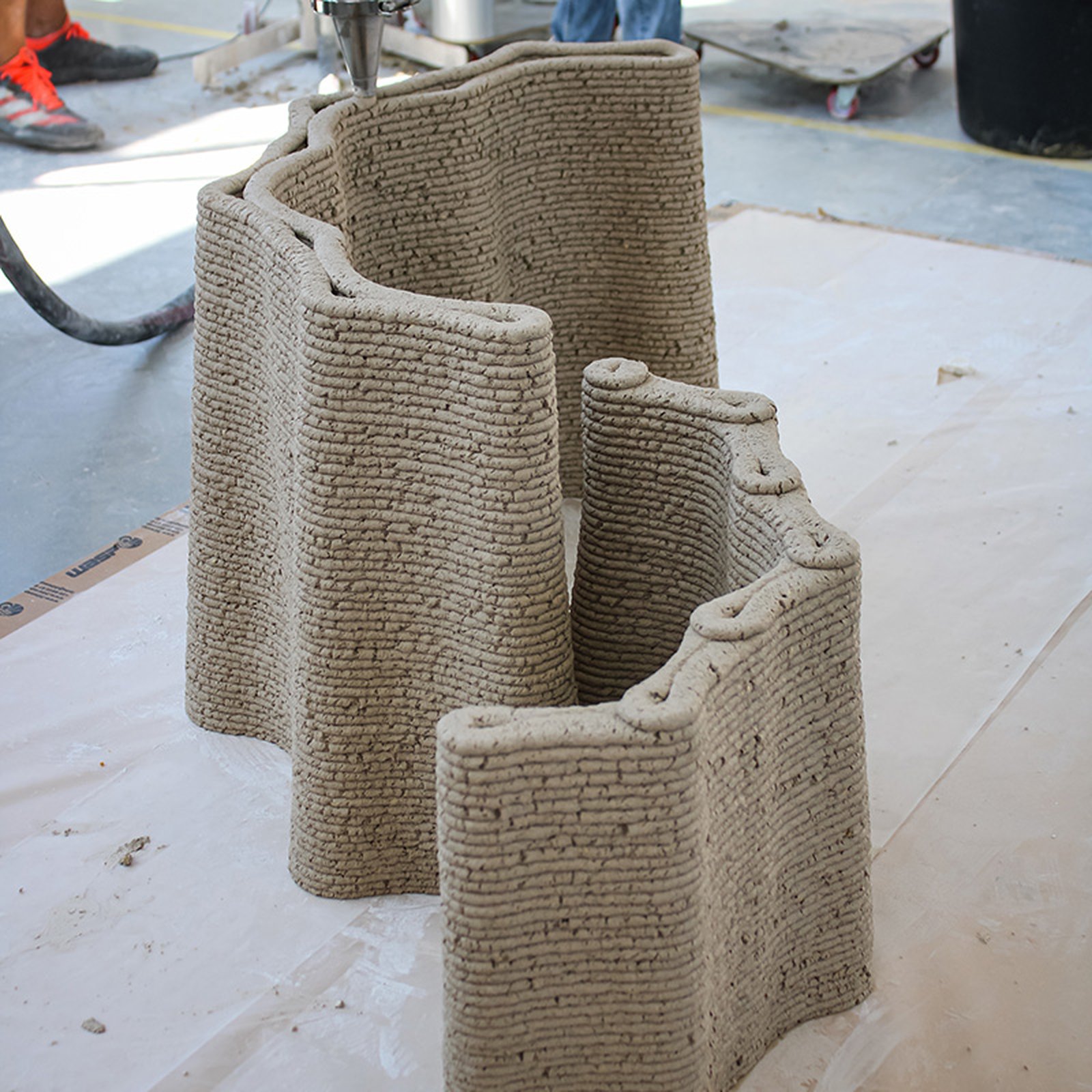
Robotic 3D Printed Construction with Corn-Lime Composites Fabrication tests were conducted during the WASP Residency 2025 in Massa Lombarda, Italy. The team used a WASP Concrete HD Continuous Feeding System mounted to a KUKA robotic arm to extrude the corn-lime mixture in successive layers. Three prototype wall panels were printed at scales from 40 cm to 80 cm in height and cured at room temperature for two to three days. The curved geometries reference terrazzo patterns from Rimini, demonstrating that the robotic 3D printed construction method can hold non-rectilinear forms with sharp surface definition.
Additive manufacturing eliminates formwork entirely, cutting material waste by up to 90 percent. Compressive strength tests confirmed the panels as components for lightweight, low-cost housing. CORNCRETL positions robotic 3D printed construction as a scalable alternative for markets where corn agriculture and unsustainable building practices intersect, converting food waste into load-bearing wall material.
The article discusses a groundbreaking sustainable construction material that could reshape industry practices, making it highly impactful and relevant for brand strategy professionals focused on sustainability.