Score
How Hana Sanchez Discovered A New Way To Animate And Brought Her Khmer Heritage To Life
Hanaé Sanchez's journey to create her debut short film 'At Last' illustrates the importance of breaking free from established techniques and labels in brand strategy. By embracing experimentation and her Khmer heritage, she developed a unique visual language that resonates with her personal narrative, highlighting the value of authenticity and innovation in branding.
Creative Boom: Insight Motion How Hanaé Sanchez discovered a new way to animate, and brought her Khmer heritage to life When the techniques she knew couldn't serve her vision, Hanaé Sanchez threw out the rulebook and found something entirely her own. Written By: Tom May 23 April 2026 There's a particular creative crisis that doesn't get talked about enough: the moment when the skills you've spent years developing start to feel like a trap. You've been labelled. You have a specialism. And slowly, almost without noticing, that specialism begins to narrow what you think you're allowed to make. Hanaé Sanchez hit that wall with animation.
The Paris-based writer-director, designer and UAL graduate had built a reputation as someone who moved fluently between live action, illustration and frame-by-frame work. But by the time she came to make At Last, her debut short film, that fluency had curdled into frustration. "I felt labelled as 'the mixed-media artist,'" she says, "and had begun to resent the tediousness of frame-by-frame work and its lack of spontaneity." She had, in effect, closed a door on herself. The vision that forced it back open At Last tells the story of Aubrey, a woman who tries to intercept an envelope to alter her own destiny.
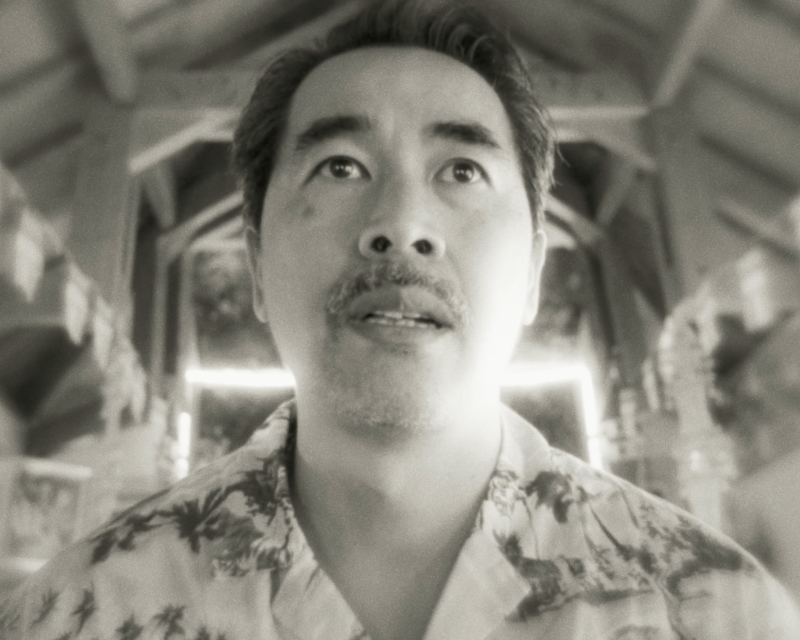
On the surface, it's a cerebral thriller; underneath, it's a deeply personal exploration of Sanchez's Khmer maternal heritage, of inherited memory, and of the possibility of bending the past. The film's live-action sequences are shot in soft black and white, with Southeast Asian furniture and decorations drifting in and out of focus in the background; the visual residue of a personal history half-known and half-imagined. But to tell the full story, Sanchez needed to go somewhere the camera couldn't reach. Inside the protagonist's inner world, the dream logic and fractured memory are at the heart of the film. That required animation.
Yet not any animation she already knew how to make. "I couldn't find a way to materialise my oneiric vision," she says. The shapes she was after were the ones she had dreamed of: strange and specific, resistant to the established techniques she tried. She worked through rotoscopy. She tried stop motion. Neither gave her what she needed. Both pulled her back toward a tediousness she had already decided she was done with. So she kept going. Weeks of not knowing What followed was, by Sanchez's own account, weeks of experimentation without a destination.
This is the part of the creative process that rarely makes it into the finished work, and rarely gets discussed in the later interviews: the sustained discomfort of pursuing a vision you can't yet articulate, through techniques that don't yet exist. The discipline here wasn't mastery. It was tolerance: the ability to stay with the problem long enough for something new to emerge. Sanchez describes it as focusing on the strange shapes she had dreamed of, returning to the images themselves when the methods failed her, and working outward from there rather than inward from a technique.
What she arrived at, she recalls, "[follows] no rulebook, but truly served the vision and the story". The result, visible in the finished film, is spectral and fractal: animations that feel genuinely strange because they came from a genuinely strange process, untethered from the conventions of any single discipline. This isn't stylisation for its own sake. The visual language Sanchez developed for the animation sequences is doing specific narrative work. The protagonist's chaotic inner world had to feel distinct from the cool, restrained world of the live-action footage, as if something were breaking through from elsewhere.
Article truncated for readability. Read the full piece →
The article showcases a unique approach to animation that integrates cultural heritage, which is significant for brand strategy professionals looking for innovative ways to connect with audiences.