Score
Apple’s HyperCard comes back to life in the form of this cool new animated browser
The emergence of Flipbook represents a significant shift in brand strategy towards experiential and visual engagement, moving away from traditional text-based AI interfaces. By leveraging the nostalgic design principles of Apple's HyperCard, Flipbook creates an interactive and immersive way for users to explore information, suggesting that future branding efforts should prioritize user experience and visual storytelling over conventional output.
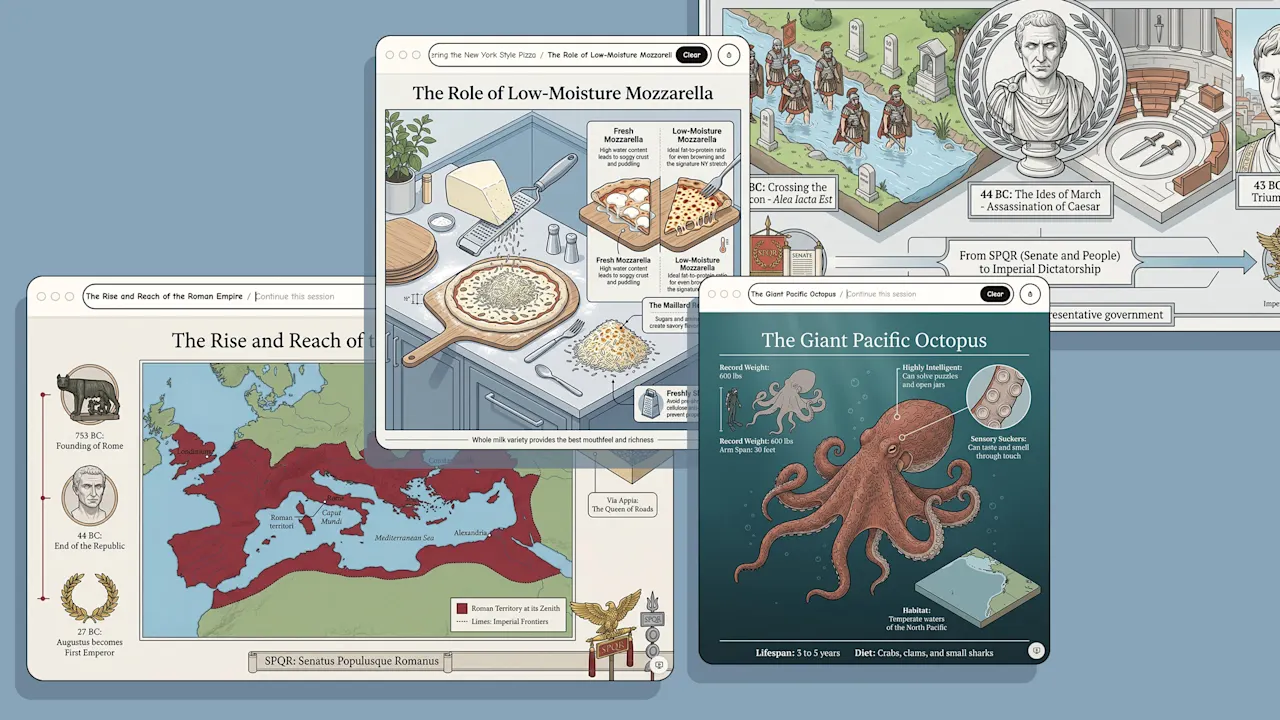
FastCompany: Flipbook feels less like just another AI product launch and more like a small revolt against the dead, rectangular boredom of the prototypical prompt-based AI interface. The project describes itself as an infinite visual browser generated on demand, in real time, where every page is an image and every click opens a deeper visual exploration of whatever caught your eye. Rather than writing a prompt and receiving a torrent of text, with Flipbook you get information from a large language model turned into a beautifully illustrated “book” page that you can click on to drill deeper into a topic. And oh boy, it feels fantastic to me.
The idea is both fresh and familiar, and it makes me want to trash Gemini forever and make my entire web experience exactly like this. (Note: video has been edited to omit loading times) [Screen capture: FC] What does Flipbook do? What makes it exciting is not just the technology, but the interface philosophy behind it. Instead of forcing people to translate curiosity into a litany of text prompts, Flipbook lets them type into a browser-like search bar and then watch as that information appears as a beautiful illustration.
Whether you’re interested in learning about the Roman Empire or the romantic jewel of Parque del Retiro, in Madrid, you’ll get a depiction of the basics of that subject. (Warning: Because Flipbook is now a prototype in a small server, it is slow and doesn’t quite render responses in real time as intended). Once the basic subject has been displayed, you can click anywhere on the page and Flipbook will dive deeper, opening a new page of the “book” with dynamically generated illustrations and text. Flipbook treats knowledge less like a database to be queried and more like a landscape to be explored.
As the creators—Zain Shah, Eddie Jiao, and Drew Carr—brilliantly put it, the current paradigm of chat boxes and rigid layouts being sold as the future “felt like sipping an ocean of wisdom through a tiny straw.” It feels like the closest thing you will get to an LLM becoming a tactile, analog experience this side of printing an actual illustrated book in real time. [Screenshots: FC] It’s HyperCard colliding with AI Flipbook immediately evokes Bill Atkinson’s HyperCard, the legendary 1987 Apple software that packed information into stacks of graphically linked visual cards.
This precursor to the World Wide Web let people move through ideas by clicking on drawn buttons and regions of a bitmap screen. In HyperCard, you could draw a house, define the front door as a clickable zone, and link it to another card showing the living room. It was a masterpiece of interactive design, but it required a human to meticulously draw and link every single card. Flipbook is the HyperCard dream fully realized by AI, capturing the same sensation of moving through knowledge spatially rather than linearly.
When you click on a visual element—say, the engine of a car or a specific mountain in a landscape—there is no pre-authored card waiting for you. The system analyzes the exact region you clicked, infers what you’re curious about, and hallucinates the next detailed card into existence in real time. It looks like the kind of beautifully illustrated stack HyperCard might have become if it had survived long enough to collide with generative AI. The real break with the web is even stranger than that comparison suggests. By Flipbook’s own description, what you see contains no HTML at all, no conventional interface elements, and no text overlays.
Article truncated for readability. Read the full piece →
The article discusses a significant innovation in digital branding that emphasizes experiential engagement, which is highly relevant for brand strategy professionals looking to adapt to new technologies.