Score
This shirt is like an AI invisibility cloak
The Digital Camouflage shirt by Simon Weckert represents a novel approach in brand strategy by merging fashion with technology to challenge surveillance systems. This adversarial clothing design not only serves a functional purpose in confusing AI but also raises critical questions about the reliability of technology, suggesting that brands can leverage innovative designs to provoke thought and discussion around societal issues.
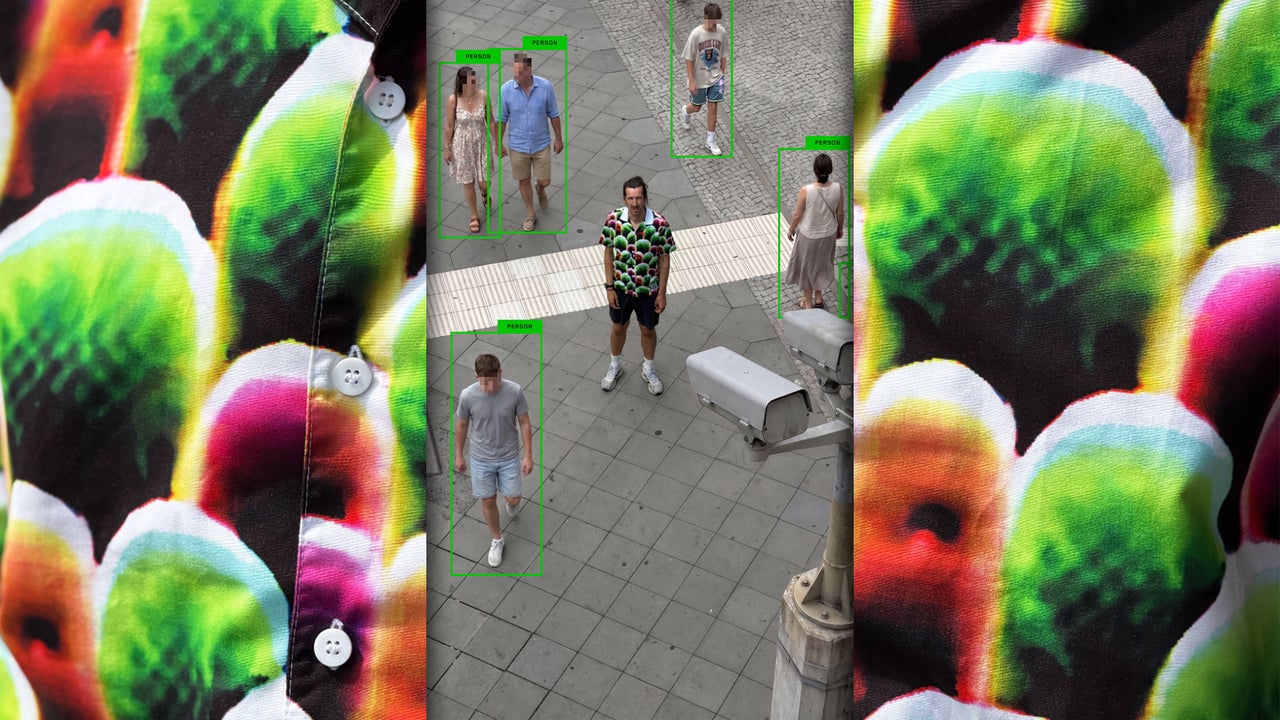
FastCompany: To the human eye, the Digital Camouflage shirt has an abstract colorful pattern showing green, pink, and orange shapes. To robots, it hides the human wearing it. German designer Simon Weckert created the button-up shirt to confuse AI surveillance systems following Berlin’s installation of surveillance cameras earlier this year. The garment is part of an emerging trend of adversarial clothing design that uses complex patterns to disrupt facial and object recognition. [Image: Simon Weckert] “Object detection systems don’t ‘see’ the way we do,” Weckert tells Fast Company .
“They scan an image for statistical patterns—combinations of edges, textures, and colors that they’ve learned to associate with the category ‘person.’” The pattern was mathematically optimized to send the wrong signals to these networks. Weckert says the shirt, available for about $88 , has to pull double duty: confound AI but also still be wearable. [Image: Simon Weckert] “The raw adversarial patterns that come out of the optimization are effective but visually chaotic—pure machine-facing imagery,” he says.
The final pattern sits in the middle ground between algorithmic needs and human taste, and he says he finds the ambiguity conceptually important. “It’s a garment addressed to two kinds of viewers simultaneously, and each sees something completely different,” he adds. [Image: Simon Weckert] Weckert tested the pattern against You Only Look Once (YOLO), an open-source detection system built on the same class of technology that powers many commercial surveillance products.
He notes, however, that the garment was not necessarily designed to defeat a specific surveillance system, but rather to raise questions about how much trust a technology deserves if a simple piece of fabric can undo it. “I make no claims about specific proprietary systems,” he says.
The point of the shirt isn’t to defeat one product, but to show a structural fragility in this entire class of technology.
The article discusses a unique intersection of fashion and technology that challenges existing surveillance norms, making it significant for brand strategy professionals looking for innovative approaches.