Score
Taste Travels Matt Dunn On How Ideas Move Through Culture
Matt Dunn emphasizes that taste is a fluid concept that evolves through culture and personal experiences, rather than being a fixed attribute. For brand strategy, this means that brands should focus on cultural references and genuine connections with their audience, rather than relying solely on traditional advertising methods. By documenting and sharing inspirations freely, brands can foster a more authentic and relatable identity.
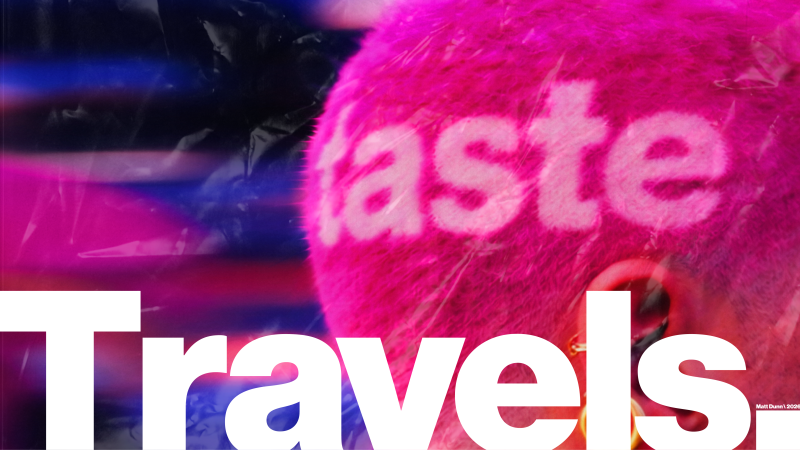
Creative Boom: Insight Creative Industry Taste travels: Matt Dunn on how ideas move through culture The global creative director discusses taste and why platforms don’t create it; they accelerate it. Written By: Tom May 1 April 2026 Visual system and creative direction by Matt Dunn Here's a phrase you've probably heard a lot lately: they have great taste. Or: their creative direction is just so tasteful. It's everywhere. It's the compliment of the moment. But as was pointed out in a recent Studio Session, nobody is actually defining what it means.
In case you didn't know, Studio Sessions are live talks hosted inside The Studio, our own private membership community, where working creatives share real project experiences with an audience of peers. In this session, titled 'How Taste Travels', creative director Matt Dunn used a recent project to launch a discussion around something broader. Matt, a New York-based global creative director who has worked across Droga5, Mother, W+K, Cash App, Goodby Silverstein and more, puts it simply: "Everyone's talking about taste," begins Matt. "but no one's defining it." His central argument is simple. Taste isn’t fixed.
It isn’t something you’re born with. It moves. It travels through culture. Through people. Through what you notice, carry, and pass on. And that changes how you approach the work. Taste, in its simplest form, moves like this: it begins with people, but it doesn't stay there. It gets remixed, referenced, reused. Platforms don't create it—people do. Platforms just accelerate it. That's Matt's central thesis, and it shapes everything about how he works. The right references Finding the right inspiration is pivotal to his creative process. "My references come from culture," he stresses. "My mood boards come from culture.
They don't come from advertising, which is weird, but it's very much how fashion designers Alexander McQueen and Virgil Abloh approached their work. They just understood the world." On a taxi ride through Chinatown in New York, Matt took photos out of the window: a storefront for something called Chinatown Fight Club (tagline: "Want to fight?"), a lorry bearing the slogan "New York City dead ass", a T-shirt that read 'Fuck You, You Fuckin' Fuck'. These all went into his phone, into the archive, alongside a year's worth of screenshots, snapped signs, and Instagram saves. "I document everything on my phone," he explains.
"I take pictures of storefronts, signs, everything." Photographer: Sam Rebbechi The point is that taste, to him, is not something to hoard; it should circulate. As he puts it: "You notice it, you carry it, and then you pass it on." Following that principle himself, he spends part of our Studio Session building out a reference document (fashion, photographers, directors, mockup links), then simply hands it to the audience. No paywall, no drip campaign, no course. "Ego is the death of everyone," he says. Which, coming from someone with Cannes Lions and a Grand Prix on his shelf, lands with some authority.
An empty shell on Grand Street To demonstrate how all of this plays out in practice, Matt walks us through his work on the Unwell NYC pop-up: a real-world brand launch for the beverage line attached to Alex Cooper's Call Her Daddy podcast (the most-listened-to podcast by women in America, and the backbone of a media empire now valued at $125 million). The starting point was a building on 45 Grand Street, Manhattan. "Inside it was an empty shell," he says. "No world, no atmosphere, no point of view, no meaning." The brief was to turn it into something that felt like more than a launch; something that felt like it had always existed.
Article truncated for readability. Read the full piece →
The article discusses a significant shift in brand strategy towards cultural relevance and authenticity, which is increasingly important in today's market, making it impactful and relevant, though the concepts of taste and cultural evolution are not entirely new.