Score
In this new Toronto neighborhood, ‘sponge streets’ double as parks and flood prevention
The innovative design of the new Toronto neighborhood, Ookwemin Minising, emphasizes the integration of green infrastructure into urban planning, transforming streets into multifunctional public spaces that enhance community living while addressing climate resilience. This approach not only increases housing density but also prioritizes environmental sustainability, suggesting that future brand strategies in urban development should focus on creating spaces that harmonize with nature and foster community engagement.
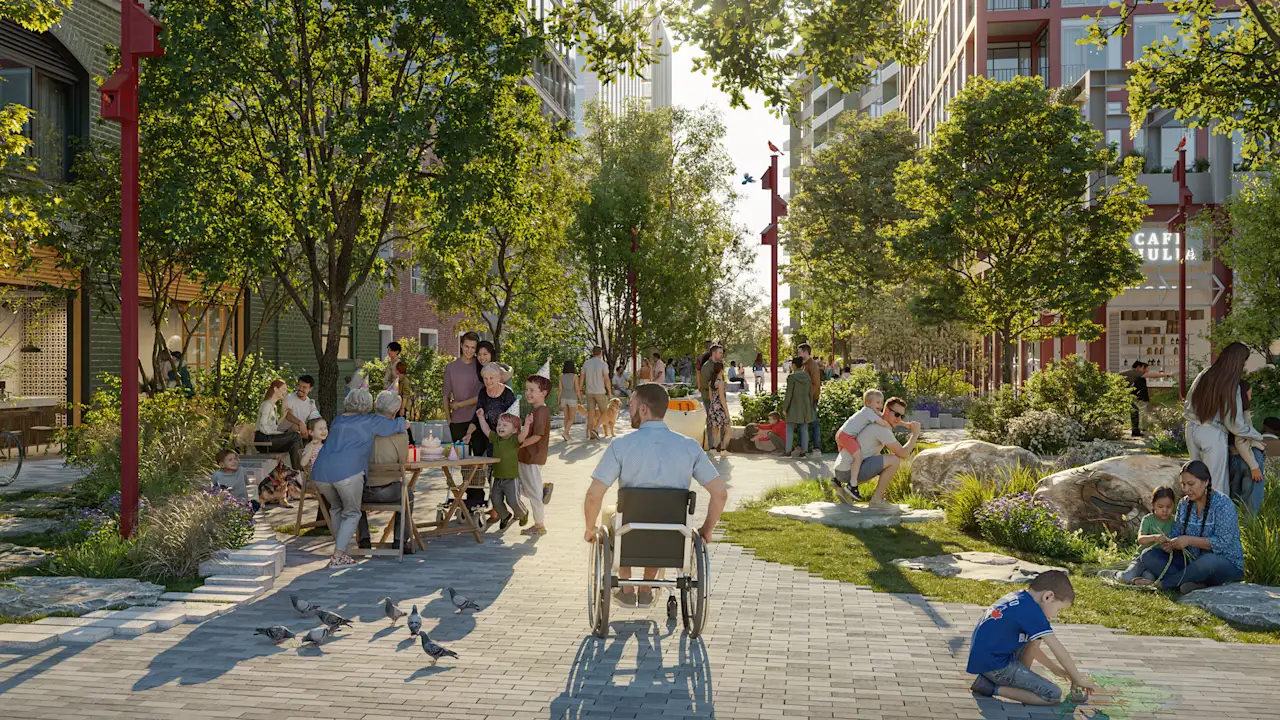
FastCompany: To make room for more housing without losing green space, planners in a new Toronto neighborhood flipped the usual approach: Instead of carving out room for parks and plazas, they made the streets do that work instead. “The street is almost like a public courtyard,” says Rasmus Astrup, design principal and senior partner at SLA, the Denmark-based firm that was part of the design team for the new neighborhood, called Ookwemin Minising . The main street will be car-free, “like a linear park,” he says, and filled with 400 trees. Other streets will allow cars, but prioritize large swaths of green space.
The design gives residents public space, and doubles as climate infrastructure that can reduce urban heat, support biodiversity, and capture water in storms. [Photo: Waterfront Toronto] Rethinking development The area, south of downtown Toronto where the Don River meets Lake Ontario, used to be industrial. More than a century ago, the city channelized part of the river and filled in wetlands to make room for factories. The old infrastructure didn’t work well: The river and industrial zone became polluted and the changes to the river led to more flooding.
But over a massive, decades-long redevelopment project, the local government cleaned up the waterfront, reshaped the river into a more natural shape, and added other new green space for flood protection. The larger project created an island where the new neighborhood will sit. The original plan for the neighborhood, released two years ago, called for more typical North American streets—wide and built for cars, lined with blocks of uniform apartment buildings.
After negative community feedback, the public development agency running the project, Waterfront Toronto , realized that the neighborhood needed more apartments to help deal with Toronto’s housing shortage. It brought in a new design team, including SLA, and asked them to come up with a new plan that would increase density by 27%. “We thought, how are we going to do that? We don’t have the space,” says Astrup. They had to get creative with their approach and conceived of streets that perform like urban spaces. “The street is where you hang out, and where you read a book, and where you sit,” he adds.
The design takes out street parking, making room for plantings and seating areas. It’s filled with trees—not just in straight lines at the curb, like typical street trees, but extending deeper into the road, so cars have to take a meandering route and slow down. On the side of one street, the “Sandbar Trail” follows the path of a former sandbar and is filled with plants. Trees will also be planted in a natural mix of species. Filling the space with nature makes it a place where people want to be. “It doesn’t work if it’s asphalt and concrete,” Astrup says.
[Photo: Waterfront Toronto] Directing the flow In a storm, the streets will suck up rainwater before it flows through traditional sewers. A “sponge” approach to street design, using green infrastructure, isn’t new. But it’s more often applied piecemeal to existing streets. Since the new neighborhood is built from scratch, planners could approach it differently. First, since the island isn’t entirely flat, the team looked at how the existing topography directs the flow of water. The designers wanted to get away from a traditional street grid.
Article truncated for readability. Read the full piece →
The article discusses a significant urban design innovation that integrates sustainability and community engagement, which is highly relevant and novel for brand strategy professionals in the context of urban development.