Score
SpaceX uses ‘chopsticks.’ China uses ‘nets.’ Here’s how these space superpowers design their rocket recovery systems
The competition between SpaceX and China's aerospace industry is intensifying, particularly in the realm of rocket recovery systems. As China successfully employs a novel net-based recovery method for its Long March-10B rocket, it highlights the need for SpaceX to innovate continuously to maintain its lead in the commercial launch market. This shift in dynamics suggests that brand strategies for both companies must now account for increased competition and the potential for rapid advancements in technology from rivals.
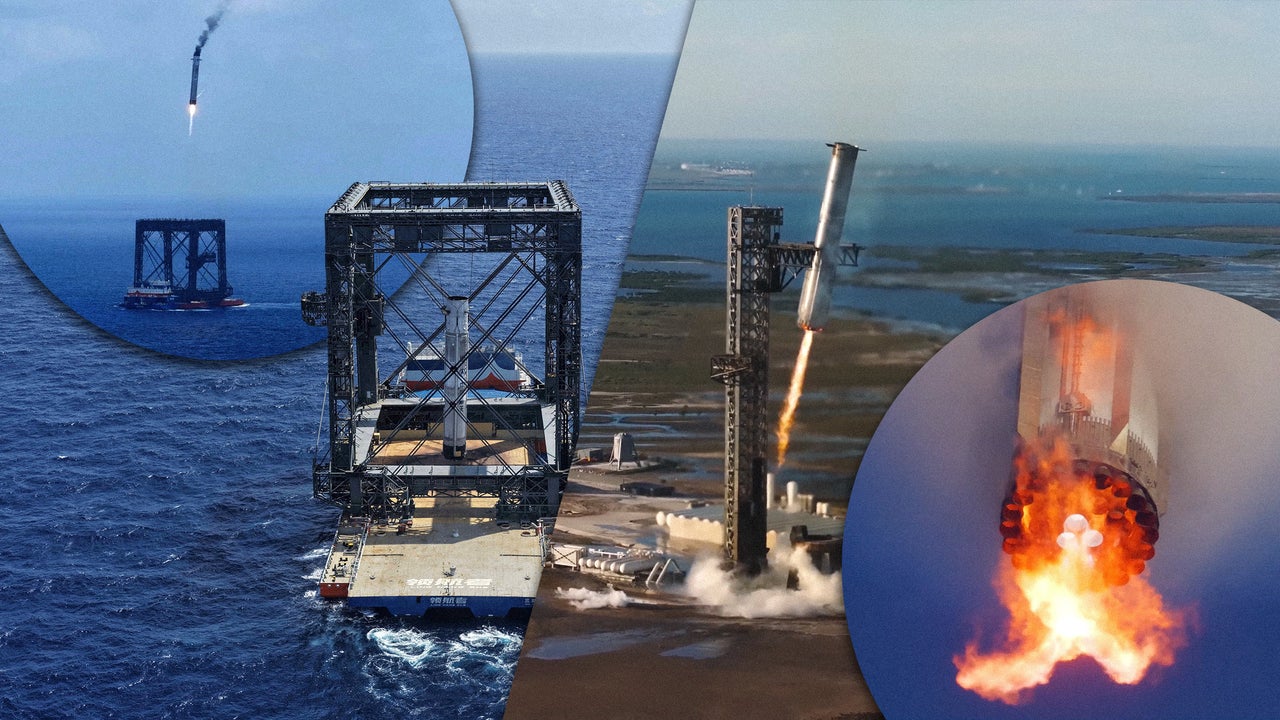
FastCompany: China is quickly closing the gap on Elon Musk’s reusable rockets in a way that should worry him more than any single competitor has before. On July 10, China Aerospace Science and Technology Corp. (CASC)—the state-owned contractor that builds nearly all of China’s rockets and satellites—launched the Long March-10B rocket on its first flight. It successfully placed its payload into orbit, and then did something that only SpaceX has managed to do: get back to Earth and dance softly, catching it midflight like SpaceX does with Starship’s Super Heavy booster.
However, instead of using the huge mechanized “chopsticks” on the launch tower at Starbase, the Chinese used a radically different system that nobody has seen before. [Image: CCTV+/Getty Images] CASC caught the falling rocket in a moving net mounted on a ship floating offshore, making it the second country ever to recover an orbital-class booster and the first in the world to do it with a sea-based net instead of legs or a tower. That distinction matters. It shows, once again, that China has developed solid space chops.
China’s aerospace industry is poised to build hardware at a scale and cost few competitors can match, and a working, reusable rocket is key to challenging SpaceX’s grip on the commercial launch market. Both systems are designed to cut the dead weight of landing legs—typical of reusable rockets like the Falcon 9—to carry more cargo. Landing legs are simply too heavy to justify flying on every mission, so both organizations deleted them entirely.
From there, though, the two programs split into fundamentally different systems: one relying on a fixed tower at the launch pad and the other on a mobile ship at sea, each with its own trade-offs in cost, precision, and how quickly the booster can fly again. [Photo: Xing Guangli/Xinhua/Getty Images] The Chinese solution The Long March-10B is a two-stage, liquid-fueled rocket with a core diameter of 16 feet. Its first stage runs on seven YF-100K engines built around an oxidizer-rich staged combustion cycle, burning a mix of rocket-grade kerosene and liquid oxygen.
This booster pushes the second stage to high altitude, releasing it so the cargo continues its way into orbit. About six minutes after the two stages separate, the first stage begins a controlled return, adjusting its pitch and using its grid fins to steer through the atmosphere toward the landing zone over the South China Sea. To slow down for the final approach, the booster reignites at least one of its restartable YF-100K engines, then descends vertically to meet the sea platform.
[Photo: Xing Guangli/Xinhua/Getty Images] That sea platform is a dedicated net-capture ship called Linghangzhe (“Navigator” in English) that is 472 feet in length and 164 feet in width. The ship holds its position using dynamic positioning technology, which keeps it stable against ocean wave disturbances throughout the recovery sequence. Most of the platform’s surface is used by a huge metallic structure in the shape of an open-faced cube that has a movable capture mechanism made of four high-strength steel cables. Two of these cables go from one top side of the cube to the opposite top side.
Article truncated for readability. Read the full piece →
The article discusses significant advancements in rocket recovery systems by leading aerospace companies, highlighting competitive dynamics that are crucial for brand strategy professionals in the tech and aerospace sectors.
Weekly digest
Get the Signal digest
Every Monday morning — the top 3 brand trends, 10 high-signal articles, and one emerging signal to watch.
No spam. Unsubscribe anytime.