Score
Three.js Conference Website Turns Community Into Living 3D UI
The Three.js conference website exemplifies a groundbreaking approach to brand strategy by prioritizing community engagement and equality in its design, transforming every visitor into an interactive 3D avatar. This innovative use of technology not only enhances user experience but also reinforces the brand's identity as a collaborative and inclusive platform, setting a new standard for event websites.
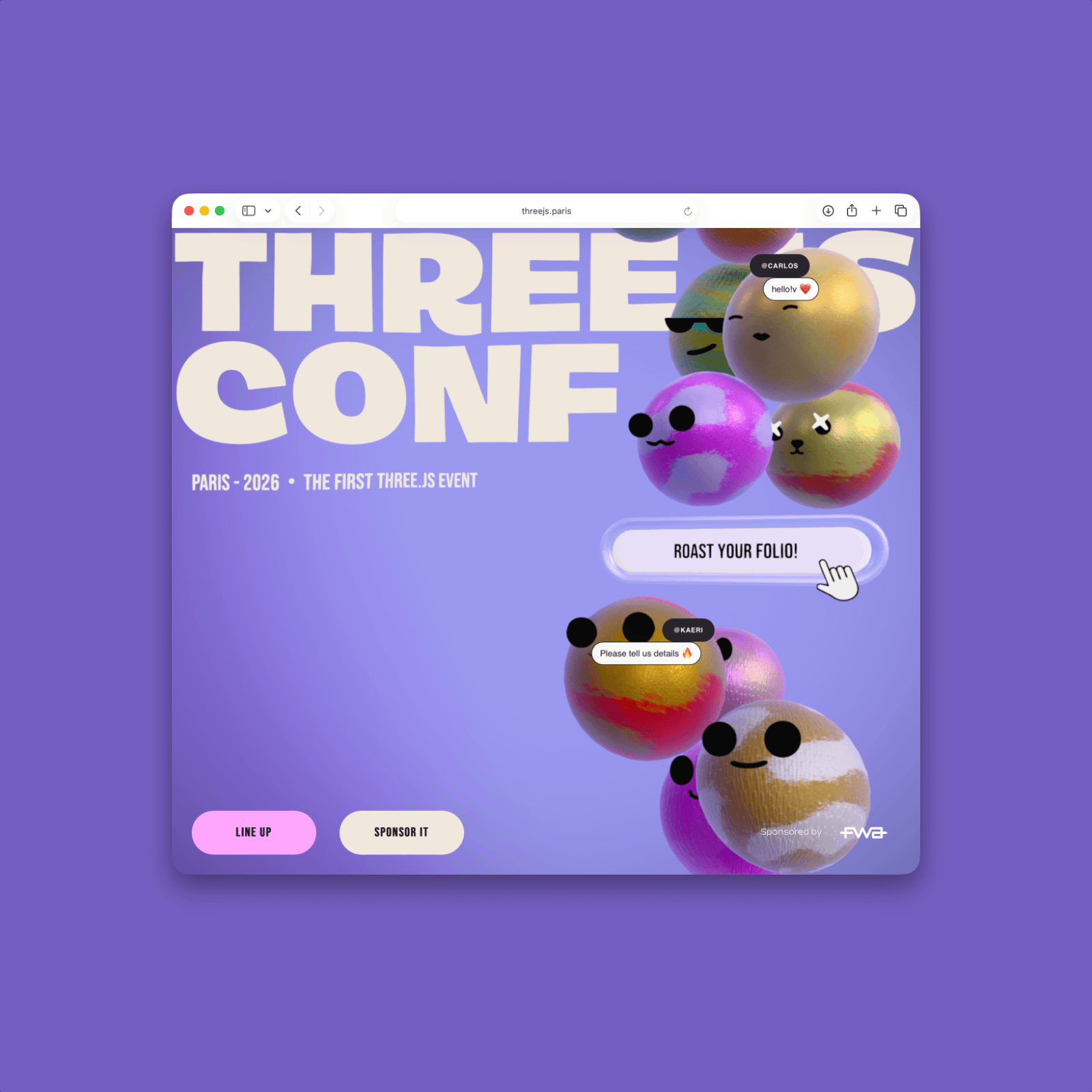
Abduzeedo: Three.js Conference Website Turns Community Into Living 3D UI jeff March 16, 2026 The Three.js conference website for Paris 2026 transforms every visitor into a physics-driven 3D sphere, all rendered in real time using WebGPU and SSGI. Makio64 and Herve Studio built threejs.paris as the official site for the first Three.js conference, scheduled for May 23, 2026, in Paris. The Three.js conference website does something no other event site has tried. Instead of placing speakers above attendees in a hierarchy, it turns every person in the community into a glowing, physics-driven 3D sphere.
Visitors and speakers share the same scene on equal footing. No pedestals, no star billing. Participation becomes interface design, and the result is a Three.js conference website that feels genuinely alive and human. The technical foundation of the Three.js conference website runs on WebGPURenderer, the next-generation rendering pipeline now supported fully by Three.js. Makio64 integrated Screen-Space Global Illumination, or SSGI, to produce realistic color bleeding between spheres. When two spheres sit close together, light bounces between them in real time. This gives the scene a warm, tactile quality that standard rendering cannot match.
The team compressed textures using the KTX2 format, packed instance data into bit-level attributes to stay within WebGPU vertex buffer limits, and offloaded physics calculations to a dedicated Web Worker thread. Every avatar on the Three.js conference website encodes its full appearance into a 10-character base62 string via a mixed-radix codec. No database entry is needed. The string alone reconstructs the entire avatar on the client side. A Three.js Conference Website Built for the Community David Ronai wrote the case study for Codrops in February 2026.
He describes how the team patched Three.js itself to fix iOS float precision errors and Android shadow rendering bugs. The buttons on the site use custom SVG shapes with 48 control points, making cursor interaction feel fluid and organic. Notable speakers include mrdoob, the creator of Three.js, and Bruno Simon.
The Three.js conference website is both a technical showcase and a community statement: code and craft can make even a landing page feel human.
The article highlights a significant innovation in event website design that emphasizes community engagement, making it highly relevant and novel for brand strategy professionals.