Score
Celebrating the 90th birthday of the Wienermobile, the original marketing stunt
The Wienermobile, celebrating its 90th anniversary, exemplifies the power of experiential marketing by creating lasting emotional connections with consumers. As brands increasingly seek to stand out in a crowded digital landscape, Oscar Mayer's iconic vehicle serves as a reminder of the effectiveness of authentic, in-person interactions in building brand loyalty and cultural relevance.
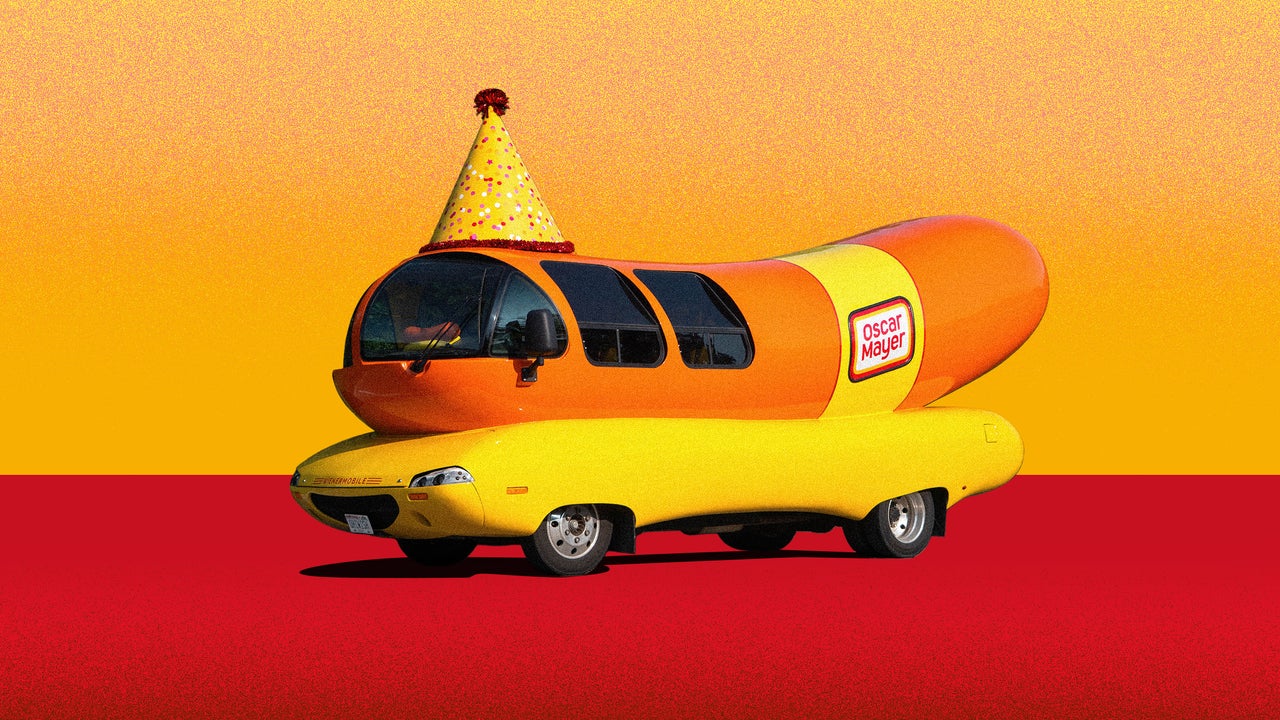
FastCompany: It’s noon on a Monday, and the Wienermobile has just pulled up outside of my Chicago apartment. Soon I’m sitting in a red-and-yellow upholstered seat with a giant plastic hot dog in front of me. Two brand ambassadors, aka Hotdoggers—who have just introduced themselves as “Grill Master Maile” and “Lindsey Links”—instruct me to “buckle my meat belt,” please and franks. As Grill Master Maile (real name Maile Carballo) and Lindsey Links (Lindsey Kulesza) traverse the nation in their giant hot dog on wheels, they’ll be ringing in an important milestone: This summer marks the 90th anniversary of the Wienermobile’s debut.
[Photo: Getty/courtesy Oscar Mayer] “The Wienermobile is one of the first examples of experiential marketing ,” Carballo tells me. “Getting out there on the streets, boots on the ground, talking to people, finding out what they want—but also just making a memory out of it, too.” Despite notching nearly 100 years on the road, the Wienermobile somehow feels more relevant now than ever before. Over the past several years, it’s been consistently requested by tens of thousands of consumers hoping to feature it at their events.
And, since 2025, it has directly boosted Oscar Mayer’s sales through the Wienie 500 , which sees all six Wienermobiles race each other at the Indianapolis Motor Speedway. Wienermobiles race at the Wienie 500 in Indianapolis on May 22, 2026. [Photo: Brandon Badraoui/Lumen/Getty Images] As social media turns digital marketing into an oversaturated hellscape, more brands are vying to catch consumers’ attention through IRL activations like pop-ups and events, hoping to score both in-person impressions and a healthy amount of user-generated content and press coverage.
The Wienermobile presages any of those efforts, yet it manages to achieve the same goals—with the bonus of decades of consumer affinity elevating it from a marketing stunt to a true cultural icon. I spoke with Kraft Heinz executives, including Todd Kaplan, Kraft Heinz North America CMO, and Molle Twing, senior experiential marketing manager for the Wienermobile program (a former Hotdogger who’s now known as the “Top Dog”), to understand how the Wienermobile’s design has changed over time, the recipe that makes it such a uniquely enduring marketing asset, and how the brand is setting it up for another 90 years on the road.
1936 [Photo: Oscar Mayer] How the Wienermobile got its wheels The year was 1936, and Oscar Mayer was a midsize meatpacking company with locations in Madison, Wisconsin, and on the north side of Chicago. The U.S. was in the thick of the Great Depression, a time when meat, especially quality meat, was considered a luxury . Carl Mayer, the nephew of Oscar Mayer’s namesake founder, had an idea. Oscar Mayer (left) and Carl Mayer [Photos: Oscar Mayer] “He went straight to his uncle and was like, ‘Hey, I’ve got this quirky idea to create this 13-foot metal hot dog to make people smile,’” Twing says. “It was a time when people needed it most.
It was a little bit of a dark day in the country, and the idea was, ‘How can we bring a little joy and make people know that Oscar Mayer stands for something much more than just good-quality, trusted meats?’” Somehow, Oscar was convinced to pursue Carl’s wild idea. The first Wienermobile was produced by General Body Co. of Chicago. It featured text enticing viewers to “Look for the yellow band,” referencing the company’s iconic packaging design, and advertising “Oscar Mayer’s German Wieners.” Open cockpits were situated at the center and rear of the car to let the driver and passengers get some fresh air.
Article truncated for readability. Read the full piece →
The article highlights the enduring significance of the Wienermobile as a case study in experiential marketing, which is relevant and impactful for brand strategy professionals, though the concept of experiential marketing itself is not new.