Score
This driverless Chinese mining truck is giant, agile, and shows the industrial future of AI
The introduction of the Shuanglin K7 driverless mining truck signifies a transformative shift in the mining industry, emphasizing the integration of advanced AI technologies to enhance operational efficiency and safety. As brands like Shuanglin Group and Tsinghua University push for automation, companies must adapt their strategies to leverage AI-driven solutions that promise to redefine productivity and reduce human risk in industrial environments.
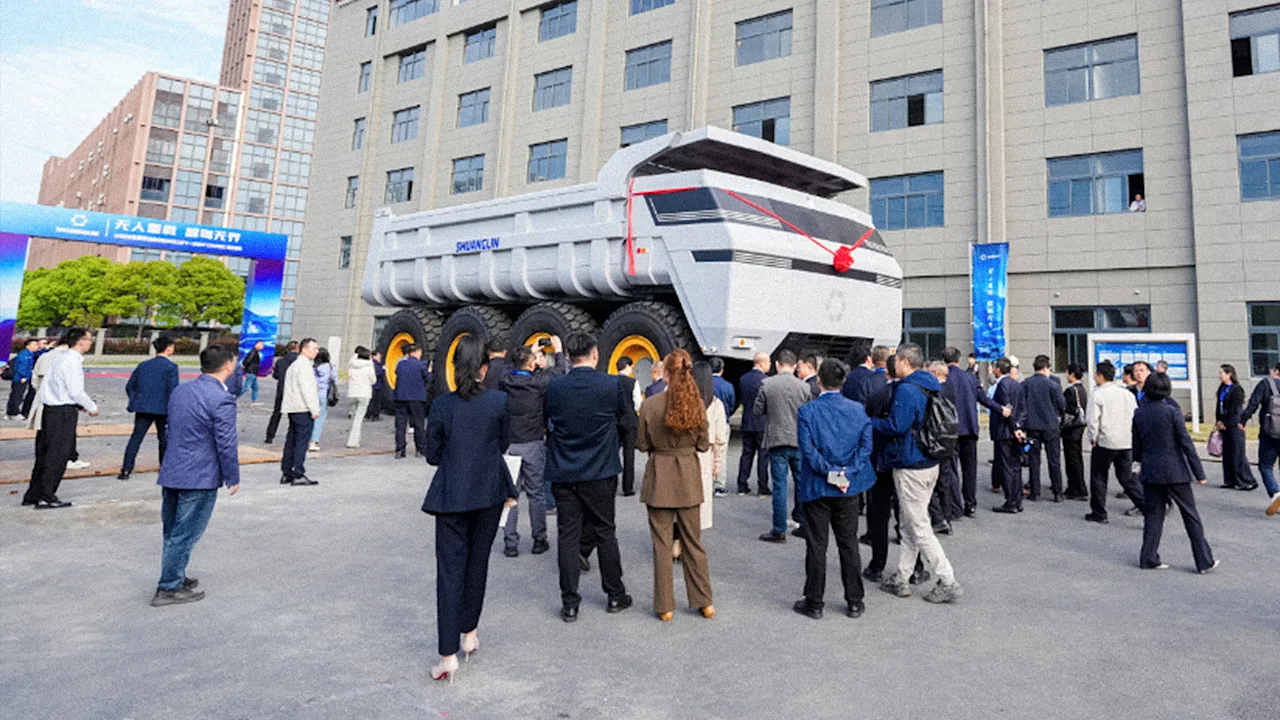
FastCompany: If you thought that embodied AI was all about humanoids and robotic good boys, allow me to introduce you to the Shuanglin K7. Equipped with a Level 4 driving brain that allows it to operate with no human intervention, this massive robot on four wheels can literally move on a dime, rotating 360 degrees on its own vertical axis and moving sideways like a crab, operating 24/7. According to its developers—Shuanglin Group and Tsinghua University—this massive 17.1-foot-tall robo-truck is the first of its kind and they believe it will forever change the mining industry.
The vehicle represents a structural shift toward replacing human operators with digital systems to improve extraction logistics and workplace safety, its inventors claim. But that’s yet to be seen. The machine now needs to prove it can solve the problems in the real world. The Shuanglin K7 measures 45.2 feet in length and 18.7 feet in width, weighing 110.2 short tons when empty. This machine’s AI brain constantly analyzes its sensors to calculate direction, speed, and routing without any human safety driver, and with, allegedly, full awareness of other vehicles and humans around it.
Provided it stays within the mapped geography of an excavation site, that is. While cars from Volvo, Mercedes, or Tesla have Level 2 autonomy—requiring the attention and hands of the drivers—the K7 can fully and safely drive autonomously through the site, recognizing all the elements typical of open pit mines. Shuanglin K7 – A new unmanned truck weighs 248 tonnes. Although civilian, it can have various military applications pic.twitter.com/ctElS2rRfw — Iron Lady (@nuwangzi) April 24, 2026 Level 4 is not the only wonder in this steel giant.
Utilizing an 8×4 drive configuration, the truck employs a distributed electronic drive-by-wire system at every wheel corner. Instead of utilizing heavy steel shafts to transfer mechanical power from an engine to the axles, this works more like a digital nervous system, sending beams of electrons to command distinct motors located at each tire. Each motor moves independently from each other, so the vehicle—which weighs 273.4 tons when fully loaded—can drive laterally, like a crab, and turn around on its vertical axis with no maneuvering whatsoever.
This means that mining sites no longer require dedicated road space just for vehicles to turn around and do their operations. Professor Huang Jin—a professor at Tsinghua University’s school of vehicle and mobility who worked on the project— told the state-sponsored newspaper Science and Technology Daily that this extraordinary mechanical ability “can greatly improve operational flexibility and site adaptability in complex environments.” According to its manufacturers, the machine supports a continuous 24/7 operational schedule thanks to its battery replacements, which only take 5 minutes to change.
The truck also “saves” energy: While descending pit inclines, the braking system captures the physics of the falling mass much like a Formula 1 car captures its inertia when braking. In theory, according to its developers, this mechanism converts up to 85% of that kinetic energy back into stored electricity, extending the working time of the truck. Computer models predict that all these features will yield a 35% output increase, a 90% reduction in site accidents, and a 25% drop in lifetime maintenance and tire costs compared to diesel machinery.
Article truncated for readability. Read the full piece →
The introduction of a driverless mining truck represents a significant advancement in industrial AI, impacting brand strategies in sectors reliant on automation, while also being a novel application of technology in a traditional industry.