Score
This new robot centaur designed to save lives is pure nightmare fuel
The introduction of Satyress's robot centaur, Threehalves, challenges conventional humanoid designs in robotics by prioritizing functionality and safety over aesthetics. This innovative approach suggests that brands in the robotics sector should focus on practical applications and user safety, potentially reshaping their strategies to emphasize unique form factors that address real-world challenges.
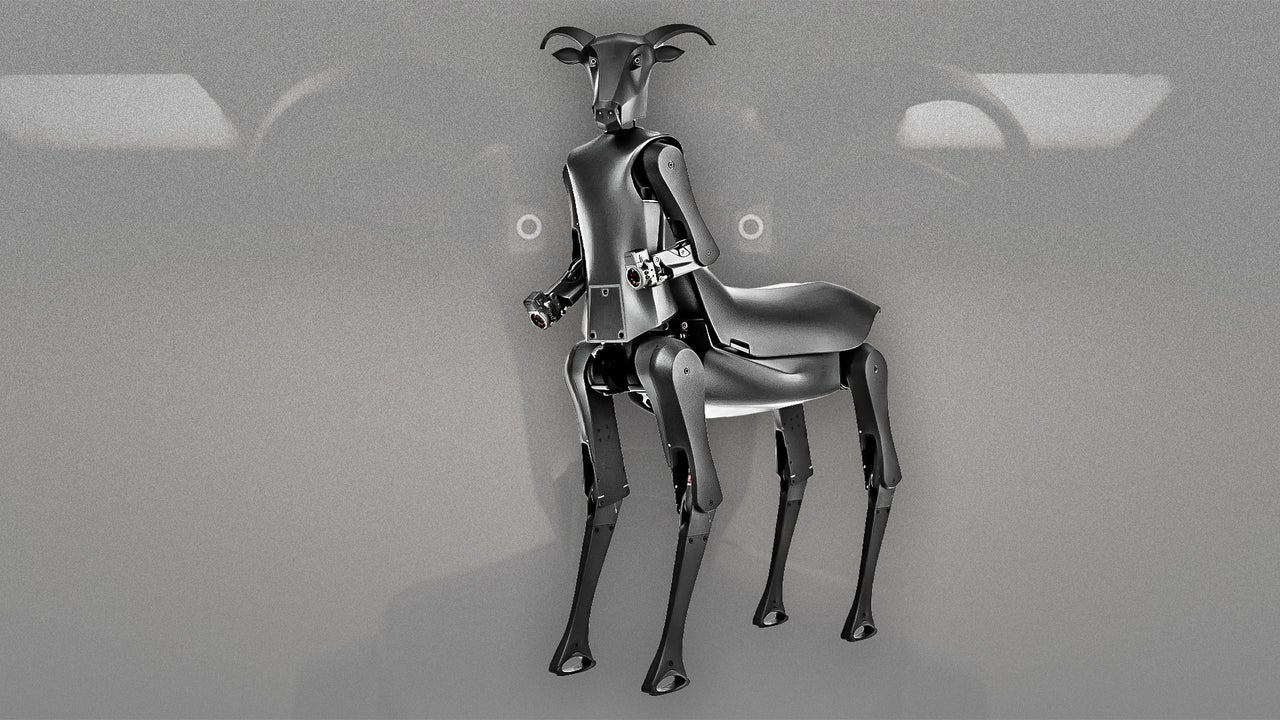
FastCompany: Somewhere in Auburn, California, a robotics startup called Satyress looked at the two great religions of modern robotics—the bipedal humanoid and the robot dog—and decided that both were not quite right. So they created Threehalves, a machine standing roughly two meters tall with a humanoid torso grafted onto a four-legged locomotion base, an angular horned skull with illuminated eyes, and power tools where its hands should be. It is, quite literally, a centaur. It’s also the stuff of nocturnal horrors. So much so, that you might think it’s a joke (Satyress did not respond to a request for comment by publication).
But strip away Guillermo del Toro’s demonic styling (a deliberate decision that connects the design to the brand, which is named after the female version of the Greek satyrs), and Threehalves becomes the latest entry in a long parade of form-factor gambling. Bipeds, quadrupeds, wheeled torsos , snake robots, drones with arms, ‘replicants’ : every lab and robot company on Earth is betting on different form factors, each one a wager on what the future robotics market will actually pay for. The design logic of Satyress is a frontal assault on humanoid dogma, but it’s not new.
NASA explored centaur-type platforms for otherworldly surface operations; the Italian Institute of Technology already experimented with a similar form , a disaster-response robot called Centauro back in the 2010s, although that one used a hybrid of legs and wheels. “Humanlike torso and arms allow for natural teleoperation and interfacing with designed-for-human tools and environments,” Satyress says on its website. Human upper bodies are useful. But the legs are a liability.
As Satyress puts it, “quadruped body with friction braked joints allows for a stable platform with no latent power consumption when not in motion, and increased stability and failsafes over a biped in both normal operation and in the event of loss of motor control.” Translation: a biped that loses power collapses onto the survivor it was dispatched to save. A centaur just stands there, brakes locked, drawing zero watts. It’s a robot design philosophy we have seen from other companies. Then there are the hands—or rather, the absence of them.
Dexterous robotic fingers are the humanoid industry’s most expensive vanity project, and their logic is that they’re too fragile for real work. So Threehalves doesn’t have any. “Quick connect wrist interface provides uncompromised tool positioning accuracy and repeatability. 12v, 18v, and 48v power, as well as air, can be provided to attachments from the robot side,” the company explains. Each arm terminates in a rugged socket that channels electricity and compressed air straight into chainsaws, drills, impact guns and wrenches . Why imitate a hand when your arm can be the power tool?
[Photo: Satyress] Work harder The whole machine is engineered for abuse. “All limbs, torso, and head can be replaced and recalibrated in minutes if damaged, and share three common fasteners for the entirety of their serviceable assemblies,” Satyress claims on its website. The machine is also designed to be easily carried around to work sites, as two of them “can fit side by side in crouched position in a pickup bed of 5’6″ [about 1.7 meters] or longer with tailgate closed.” But it’s not only its form that separates Threehalves from every other humanoid out there: the robot has zero autonomy.
Article truncated for readability. Read the full piece →
The article discusses a significant innovation in robotics that could influence brand strategies, though its direct application to brand strategy professionals may be somewhat limited.