Score
China is designing a floating, nuclear-powered shipping port of the future
Jiangnan Shipyard's innovative design for a floating, nuclear-powered shipping port represents a significant shift in maritime infrastructure, aiming to create a self-sustaining, zero-emission logistics ecosystem. This strategy not only positions China as a leader in the future of global shipping but also emphasizes the importance of integrating advanced technology and sustainability into brand strategy within the shipping industry.
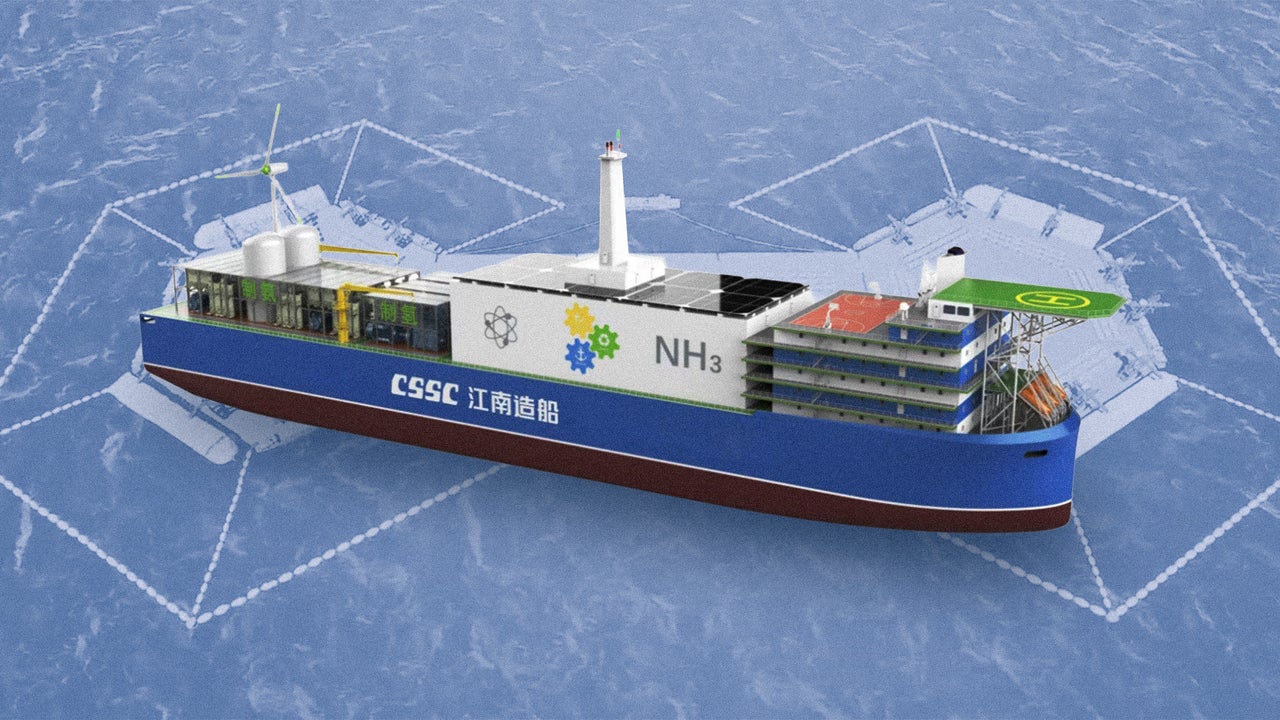
FastCompany: Jiangnan Shipyard, a subsidiary of China State Shipbuilding Corp., has designed a massive offshore facility that functions simultaneously as a container terminal and a ship-recharging station. The floating island will be powered entirely by nuclear energy and renewable sources. The company wants to replicate the design and deploy these facilities across the world’s most critical shipping routes. This has the potential to create a network of ports outside any country’s ports, in open seas.
Not happy with dominating the global supply chains for key industries (like rare earths and magnets for embodied AI and cars), manufacturing , and shipbuilding , Beijing has its eyes on dominating the shipping routes too. The concept, unveiled at Posidonia, an international shipping exhibition in Greece, is engineered to manufacture its own zero-carbon fuels, supply electricity to docked electric feeder ships, and run on a self-sustaining energy loop that produces no direct carbon emissions. If built, this platform would not need a port, coastline, or national grid. It would be its own port, existing at sea, doing its job.
This is not the first time that China is trying to extend its tentacles with big floating structures. The country is already building strategic research platforms designed to extend its scientific and geopolitical power far outside its borders. [Rendering: Jiangnan Shipyard] The shipping industry moves roughly 80% of world trade by volume and remains one of the hardest sectors to decarbonize, locked into fossil fuel infrastructure built across a century. Jiangnan’s proposal is an answer to that structural problem.
The company says the complex would “become a new ecosystem for zero-emission ocean container logistics” and deliver a “groundbreaking solution for the global shipping industry’s carbon neutral transformation.“ It’s a declaration that China intends to own the architecture of the next era of maritime trade, from the ships to the fuel to the ports themselves. How it would work At the center of the platform sits an advanced molten salt reactor, a nuclear technology that uses liquefied salt simultaneously as fuel and as a coolant, eliminating the need for the water-based cooling systems that conventional reactors depend on.
“Molten salt reactors inherently avoid the risk of the core melting, and have inherent safety and non-proliferation characteristics,” Jiangnan said at its presentation. “When the molten salt coolant comes into contact with environmental temperatures, it can rapidly solidify, greatly reducing the risk of accident-related leakage.” In the event of a breach, the liquid salt does not spill and spread. It freezes. The failure mode of the reactor is, by design, self-limiting. China has already demonstrated how the technology works. It is running an experimental thorium-based molten salt reactor in Wuwei, a city on the outskirts of the Gobi Desert.
This 2-megawatt thermal reactor achieved criticality in October 2023, reached full power in June 2024, and successfully demonstrated the conversion of thorium to uranium fuel in late 2025. The Shanghai Institute of Applied Physics of the Chinese Academy of Sciences has also demonstrated that a thorium-based molten salt reactor can transmute thorium-232 into uranium-233, which is in itself a scientific milestone that proves the technical feasibility of the entire nuclear fuel cycle. Thorium exists in greater quantities on Earth than uranium and is significantly easier to extract.
Article truncated for readability. Read the full piece →
The article discusses a groundbreaking approach to maritime infrastructure that could reshape logistics and sustainability practices, making it highly impactful and novel, while also providing relevant insights for brand strategy professionals focused on innovation and sustainability.