Score
This wooden 10-story office building wiggles to withstand earthquakes
The Hive, a 10-story wooden office building in Vancouver, showcases innovative mass timber construction that not only reduces greenhouse gas emissions but also enhances seismic resilience. This trend signals a potential shift in brand strategy for architecture firms like Dialog, emphasizing sustainability and safety in building design, which could redefine industry standards and attract eco-conscious clients.
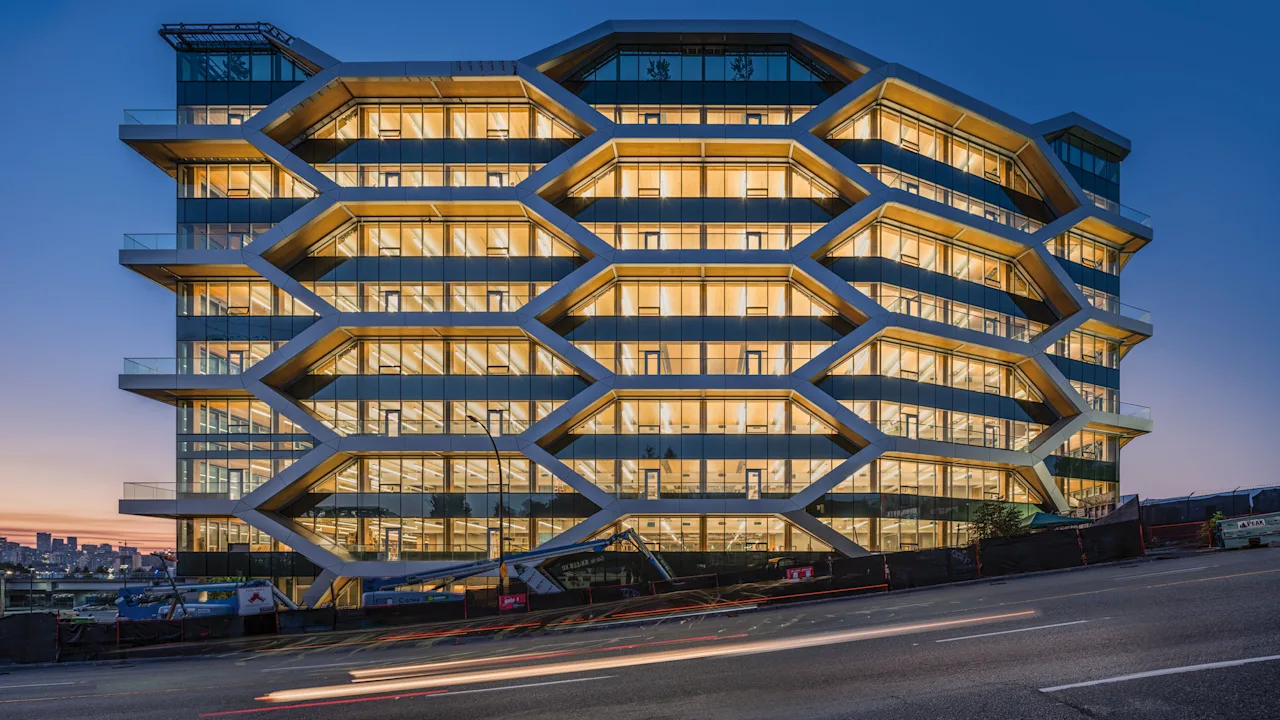
FastCompany: As visitors head into downtown Vancouver through the city’s False Creek Flats neighborhood, the first thing they’ll see is the Hive: a 10-story office building built out of wood and shaped like a giant honeycomb. Beneath its webbed exterior, the building is hiding a clever design system that keeps it safe from earthquakes by allowing it to wiggle, shake, and settle. The Hive, designed by the Toronto-based architecture studio Dialog , is the tallest seismic-force-resisting building made from mass timber in North America.
By substituting mass timber for typical steel-and-concrete construction, the building is sequestering a total of 4,403 metric tons of CO2; equivalent to taking 1,300 cars off the road for a year. And, according to Martin Nielsen, a partner at Dialog, mass timber is naturally more resilient to seismic activity than steel and concrete. Despite these advantages, tall mass timber buildings like the Hive are rare. Whereas wood construction was the norm pre-20th century, the mass production of steel and concrete made those materials the dominant building resources over the last century.
Recently, though, interest in mass timber construction has resurfaced in cities like New York , Milwaukee , and Vancouver, among others, as a way to reduce greenhouse gas emissions. As of now, there are around 2,700 mass timber buildings either constructed or in the works in the U.S.—more than double than back in 2022. In earthquake-prone regions like western Canada, this renewed interest means that architecture firms like Dialog are beginning to experiment with strategies that can make mass timber buildings both more common and more safe. With the Hive, their solution is a system of joints that take a key design cue from tectonic plates.
“Concrete is the worst” The concept for the Hive started around a decade ago when an organic farming company looking for a new headquarters approached Nielsen. While that client ultimately couldn’t use the space (the building will now serve as offices for the Insurance Company of British Columbia), the initial mandate remained in place: a sustainable, wood-based building that would help pave the way for future mass timber developments in Canada. Using timber to build at scale certainly isn’t unheard of.
Other examples do exist, like Milwaukee’s 25-story Ascent MKE Building , Norway’s 18-story Mjøstårnet tower, and the University of British Columbia’s 18-story Brock Commons Tallwood House , but they’re largely the exception to the rule. The issue, Nielsen says, is that building codes and policies have been structured around steel and concrete construction since the Industrial Revolution. The cost efficiency of concrete, as well as timber’s potential fire risk factors, are two key factors that have become baked into those policies over time.
Even after a developer goes through the arduous task of gaining approvals for a mass timber building, they then have to contend with much higher insurance premiums. And, in the case of the Hive, which is located in a region with strict building requirements because of potential seismic activity, Dialog was facing the added stipulation of designing an ultra-earthquake-safe wooden structure. However, according to Nielsen, while steel and concrete have been the default building materials for decades, wood actually has a natural ability to resist seismic force.
Article truncated for readability. Read the full piece →
The article discusses a significant architectural innovation that could influence brand strategies in the design industry, particularly in sustainability and safety, making it highly relevant and impactful.