Score
Hussein Shikha Weaves Pixels Carpets And Cultural Memory Into Extraordinary Tapestries
Hussein Shikha's work exemplifies a unique blend of digital and traditional craftsmanship, emphasizing the importance of cultural memory and storytelling in brand strategy. By weaving pixels and cultural narratives into his tapestries, he invites audiences to engage with art in a slower, more reflective manner, which can inform brands looking to create deeper connections with their consumers through storytelling and heritage.
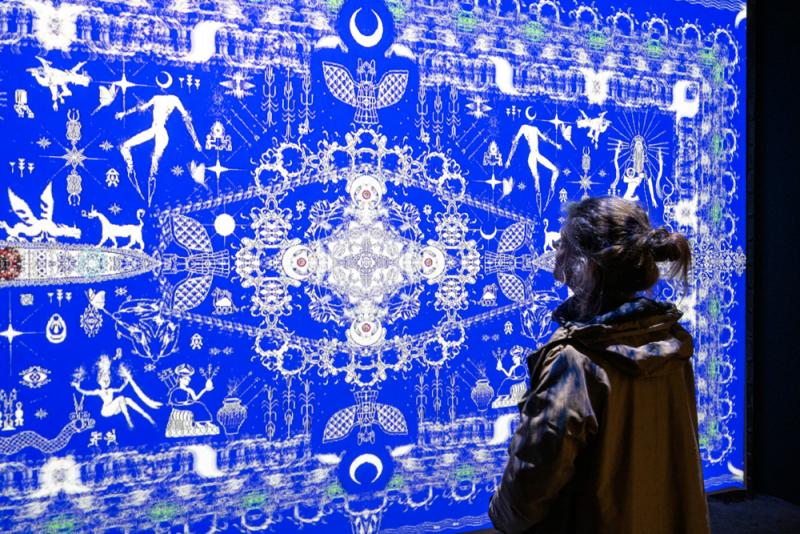
Creative Boom: Inspiration Art & Culture Hussein Shikha weaves pixels, carpets and cultural memory into extraordinary tapestries The Baghdad-born, Antwerp-based artist combines digital image-making with southern Iraqi visual culture, Shia Islamic history and Mesopotamian mythology to create layered jacquard-woven works. Written By: Ayla Angelos 20 July 2026 As a child in Baghdad, Hussein Shikha spent a lot of time indoors, and the electricity came and went in unpredictable bursts. When the power cut out and his PlayStation screen went dark, his eyes would drop to the carpet beneath him – its geometry, figures and the tight patterns of warp and weft.
That switch between the pixel and the knot, the digital and the woven, is where his practice really began. Today, Hussein is an Antwerp-based artist and researcher working across jacquard-woven tapestry, animation, video installation and a video game he's been building for six years. Born in Baghdad in 1995, he moved to Belgium with his family in 2009, went on to study at the Royal Academy of Fine Arts Antwerp, and completed a postgraduate degree in Research in Art and Design at Sint Lucas Antwerp.
His work has since been shown at the Nieuwe Instituut in Rotterdam, BAK in Utrecht, the TextielMuseum in Tilburg and Kunsthal Extra City in Antwerp. In 2025, he received the Pomona Art Fund Grant from SOFAM and the King Baudouin Foundation. He completed a residency at the Jan van Eyck Academie, during which he produced his most ambitious body of work to date. For Hussein, the connection between weaving and computing runs deeper than metaphor. The Jacquard loom used punched cards to programme its patterns, a mechanism that directly influenced Charles Babbage's Analytical Engine, one of the earliest concepts for a programmable computer.
"The pixel, in a sense, descends from the loom," he says. "That lineage is not incidental to how I work." Everything he makes begins pixel by pixel, placed manually at scale and by hand – "a form of digital craft," as he puts it, "slow and labour intensive in its own way, not unlike weaving itself." Because the imagery is already pixelated on screen, "the translation into weaving becomes almost seamless," carried out with weaving mills and institutions like the TextielLab in Tilburg.
That instinct for craft and continuity shapes everything Hussein draws on: Mesopotamian mythology, Islamic ornamentation and calligraphy, the folkloric world-building of manga and video games. Carpets, in particular, run through his whole life. "Carpets have always been present throughout my life, not only as objects but as carriers of stories, symbols and memory," he says. He talks about inspiration itself as something he's a custodian of. "It's something that has been carried by people before me, passed down and around and through generations, transformed until it arrives to me," he says.
"What reaches me has already moved through many hands, many lives, many losses. It is only passing through me, and I hope to pass it along as well." That sense of custodianship is evident in They Who Saw Nothing but Beauty, a series of seven jacquard-woven tapestries made during his Jan van Eyck residency, depicting moments connected to the martyrdom of Imam Hussein at the Battle of Karbala – a pivotal event in Shia Islamic history, and one Hussein knew firsthand through the pilgrimages his family made to Karbala while living in Baghdad.
Article truncated for readability. Read the full piece →
Hussein Shikha's innovative approach to merging digital art with traditional craftsmanship offers significant insights for brand strategy professionals focused on storytelling and cultural identity.