Score
Give It All Youve Got Why Rob Lowe Is Raiding His Past To Fight The Future
Rob Lowe, known as Supermundane, is leveraging his extensive experience to create a series of prints that push back against the blandness of AI-generated art. His work emphasizes the importance of depth, personal specificity, and the value of human creativity in an era dominated by algorithmically produced visuals, advocating for a brand strategy that prioritizes authenticity and individuality over mass appeal.
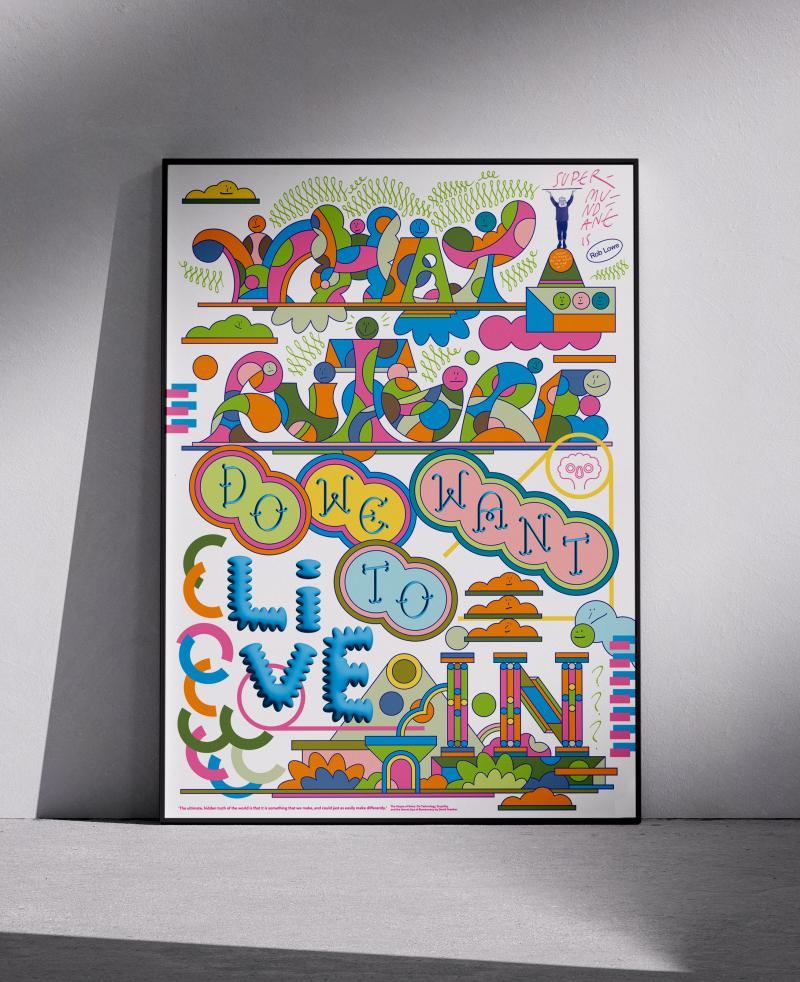
Creative Boom: News Rob Lowe's latest prints are raiding his past, to fight the future The veteran artist known as Supermundane has drawn on three decades of accumulated skill to fight back against AI's creeping homogenisation of visual culture. Written By: Tom May 28 April 2026 There's a particular kind of confidence that comes only from experience: the confidence to throw everything at the wall and trust that it'll hold. Rob Lowe, the artist and illustrator who works under the name Supermundane, has that in abundance. And his new series of prints, Let's Give It All You've Got, is the most maximalist, layered and deliberately unruly work of his career.
It's also, he'd argue, some of the most necessary. "I'm feeling bored and bullied by AI," he says, plainly. Rob is now in his fourth decade of working creatively, and the accumulated weight of that experience, rather than mellowing him, seems to have made him considerably more annoyed. As AI-generated imagery floods feeds, pitches and in-house briefs with what Rob calls "veneer-thin generated graphics", he's responded not with a polemic essay or a LinkedIn post, but with 12 large-format prints that are almost aggressively alive. They are accompanied by a memo that serves as a manifesto.
It begins: "In a time of instant slickness and bland, veneer-thin generated graphics, we need more depth, more surprises, more humanity." It ends, gloriously, with: "Layers, layers, layers!" It's a rallying call dressed in the clothes of an internal office document. This isn't someone retreating into nostalgia. It's someone going on the offensive. How he made them What makes the prints so visually striking is that they're genuinely the product of what the memo preaches.
Rob describes a process more akin to painting than to the graphic design work he's known for: building up layers, scanning in hand-drawn lettering and watercolour marks, creating 3D elements, then reacting to accidents and happy mistakes. "In their early stages, there is little hint of how they will end up," he says. "I keep adding and taking away." The results look like it. 01/09 His signature geometric style is still very much present, but it's now in conversation with looser, older, more vulnerable material. Some elements trace back nearly 30 years, to biro-scrawled sketchbook pages.
Others draw on his experience art directing magazines, including the much-loved Anorak and Fire & Knives, where designing and commissioning lettering was central to the work. None of it feels retro. It feels like someone is finally using every tool in the workshop at once. The prints are designed to be output at 50cm x 70cm, a deliberate choice. At that scale, there's room to hide things, to reward the patient viewer with details that thumbnails would simply swallow: "These are not made with the limitations of social media in mind," Rob notes.
An uncomfortable truth Here's the uncomfortable truth lurking behind the work, the thing that makes it relevant well beyond Rob's own practice. AI systems are extraordinarily good at producing work that looks competent, and extraordinarily bad at producing work that means anything. They're trained on the visual internet, which means they're trained on the accumulated output of designers, illustrators and artists, then they sell it back at a discount, stripped of context and intent. The result is not just aesthetically bland; it's epistemically hollow.
Article truncated for readability. Read the full piece →
Rob Lowe's initiative to highlight human creativity against AI-generated art is significant and timely, offering fresh insights into brand strategy that emphasize authenticity in a digital age.