Score
Delta’s swanky new suite is designed for side sleepers
Delta's new Delta One suite design emphasizes comfort for side sleepers, reflecting a broader trend in the airline industry towards premiumization aimed at attracting high-income travelers. By enhancing the in-flight experience with luxurious seating and amenities, Delta aims to distinguish itself as a premium brand, which has already resulted in significant revenue growth from premium ticket sales.
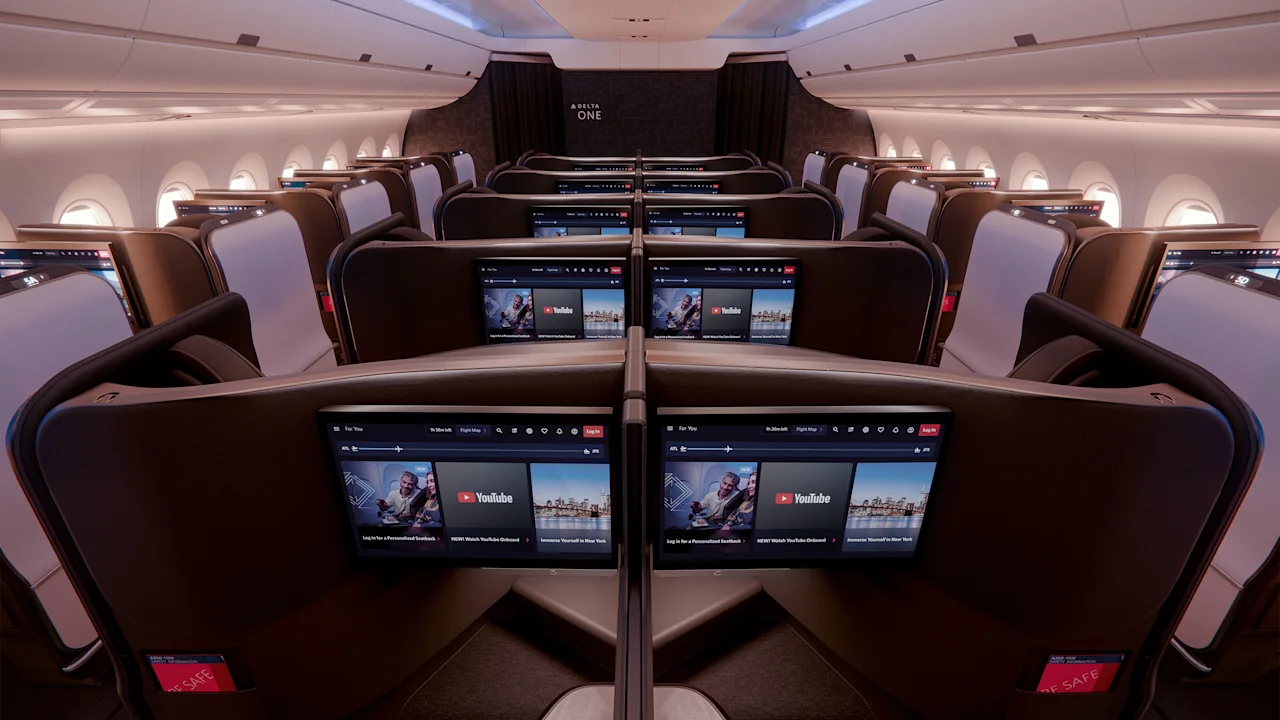
FastCompany: Delta just unveiled the new version of its most premium seat, and it’s designed to let passengers stretch out just like they would in their bed at home. On April 13, the company announced that the “next generation” of its Delta One suites, which are made for long-haul international and domestic flights, will debut in early 2027 on new Airbus A350-1000 aircraft. The updated design will include a flat bed that’s been expanded by more than three inches, a custom cushion to act like an in-air mattress, and a new cubby to store shoes.
Delta’s announcement comes just weeks after United (the second-largest airline by revenue behind only Delta itself) officially debuted its new Polaris Studio , an ultra-luxe seating option that’s 25% larger than its previous top-tier seat. Both of these moves are part of a broader focus on premiumization in the airline industry, aimed to attract and retain high-income fliers. As the sector’s biggest players double down on the most luxe in-flight experience possible, the race to design the most comfortable lie-back seat is officially on.
[Photo: Delta] Inside the airline industry’s ultra-premium seats race For the past several years, Delta has been on a mission to, as CEO Ed Bastian put it to Fast Company in 2024, “distinguish around service and having a premium brand.” So far, that effort is paying off: After the company began rolling out a more premium, redesigned cabin across its fleet in 2025, its total premium ticket revenue (which includes Delta First, Delta One, Delta Premium Select, Delta Comfort) was $22.1 billion, a 7% year-over-year increase, according to a press release .
And in 2026, despite increased jet fuel prices due to the U.S.-Israel war in Iran, Delta hit a record March quarter revenue of $14.2 billion. The achievement was driven in large part by premium ticket revenue, which has almost overtaken the company’s main cabin revenue for the first time ever. It also recently raised checked bag fees . In an April interview with Fortune , Bastian explained , “Delta is not a low-cost airline. We can’t win by trying to provide the cheapest. We have to be able to win by providing the best.” Delta isn’t the only airline living by that philosophy.
Recently, experts have posited that we’re squarely in the midst of a K-shaped economy—basically, an economic recovery model in which higher-income individuals rise while lower-income consumers fall behind . [Photo: Delta] And, as Fast Company has written before , that trend is becoming increasingly glaring in the airline industry: At the same time that carriers are piling on heaps of added fees for lower-income fliers, they’re dedicating even more effort to making their “premium” seating more attractive to high-income customers.
One way to do that is with new amenities, like luxury lounges and in-flight treats (both of which Delta has already invested in ). Another is to double down on ultimate seat comfort—and several airlines have already made strides in that arena. In 2021, Jet Blue debuted new business class seats designed by a mattress start-up. United’s new Polaris Studio (available in ultra-limited quantities of eight to a plane) comes with expanded leg room, the largest touchscreen on any U.S. airline, and complementary caviar .
Article truncated for readability. Read the full piece →
The article discusses a significant rebranding effort by Delta Airlines that aligns with industry trends, making it impactful for brand strategy professionals, while the focus on side sleepers adds a unique twist to standard airline offerings.
Weekly digest
Get the Signal digest
Every Monday morning — the top 3 brand trends, 10 high-signal articles, and one emerging signal to watch.
No spam. Unsubscribe anytime.