Score
How Apple made its charming claymation Mac mini ad
Apple's latest Mac mini ad showcases a return to human craftsmanship in advertising, utilizing stop-motion claymation to highlight the product's capabilities while emphasizing creativity. This strategy not only differentiates Apple in a landscape increasingly dominated by AI-generated content but also aligns with its recent efforts to inject more personality into its brand, particularly targeting younger audiences through platforms like TikTok.
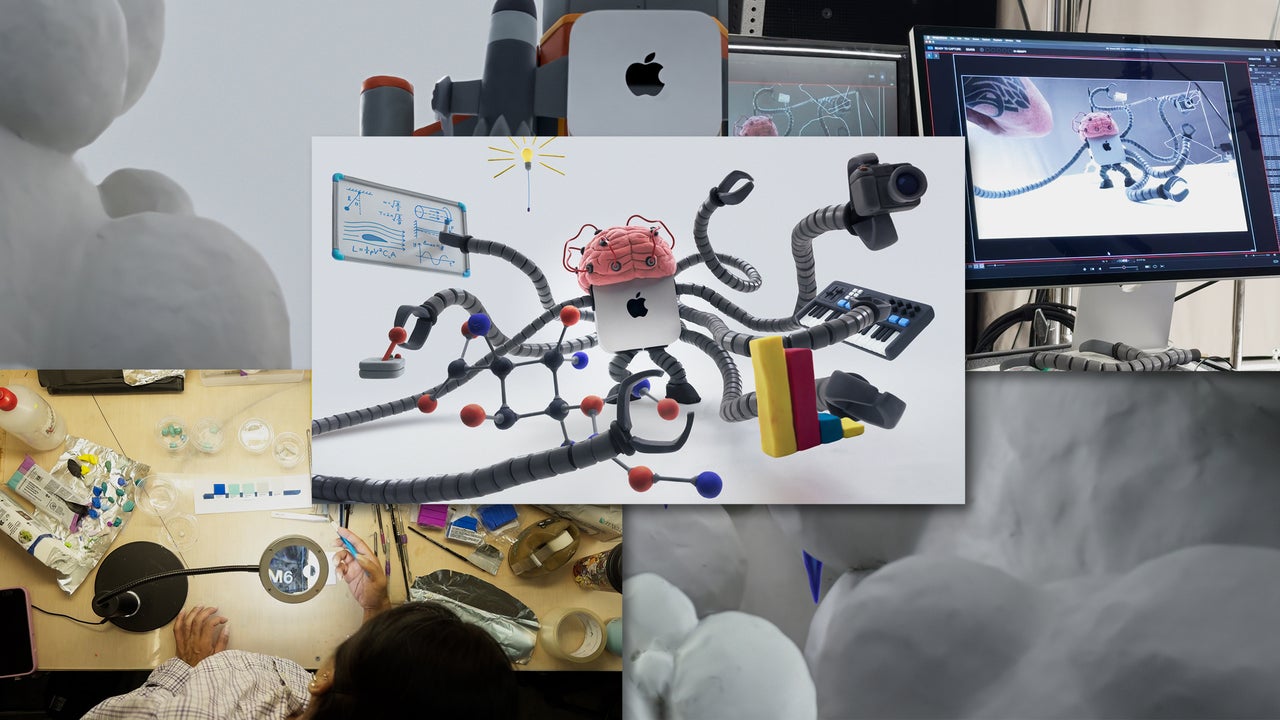
FastCompany: In Apple’s newest ad, its Mac mini is a muscly bodybuilder, a donut-spinning race car, and a rocket ship blasting off. Every one of those characters was made out of clay. The spot, which debuted on August 25, was created by TBWA\Media Arts Lab (MAL) (a bespoke global agency that partners only with Apple) to mark the launch of the new Mac mini , which is the company’s line of screenless desktop computers. The $899 device runs on the M6, Apple’s first 2-nanometer chip, which significantly improves storage, graphics, and AI performance.
In just two days, the spot introducing the new product has amassed more than 16 million views on YouTube , while an accompanying behind-the-scenes video has hit a whopping 188 million views on Instagram . To capture the concept of the Mac mini’s small stature (it measures just 5 inches by 5 inches) but mighty capabilities, the teams at Apple and MAL decided to reimagine the computer as a series of tiny characters with outsize personalities. And, to keep the human craft behind the project at the forefront of viewers’ minds, no CGI or AI was used for the animation.
Everything seen in the film, from the characters themselves to the expressive motion lines, was physically built out of clay and animated in stop-motion. Animating the Mac mini Creating the Mac mini spot took nine weeks from start to finish, and its animators were working on a deadline to have the ad ready for the product’s launch date. Despite the time crunch, they didn’t cut any corners when it came to practical effects. To build all the miniature set pieces, a team of animators used soft, malleable clay, oven-bake clay, medium-density fiberboard, and two-part epoxy putty.
While on set, animators created every effect by moving, carving, and shaping the props by hand. The effort included building a tiny clay keyboard, camera, and whiteboard; designing a fleshy brain for the Mac mini; and capturing believable puffs of smoke with clay. [Image: Apple, TBWA\Media Arts Lab] Each scene required its own artistic technique: In the opening bodybuilder section, for example, the muscle shape was created using 3D sculpts, which were printed and used as molds. Actual clay was pressed into the molds to make the shapes seen on camera, supported by internal armatures that helped maintain the poses between frames.
Because the bodybuilder is shown progressively beefing up during the spot, the team built arms and legs of different sizes, which were then hand-carved to achieve the transitional frames. [Image: Apple, TBWA\Media Arts Lab] The only digital work in the spot involved removing rigs and performing minor cleanups, which is standard in stop-motion production. Any blips or imperfections ultimately add to the spot’s charm. By leaning on practical effects, it manages to convey the Mac mini’s computing power while also emphasizing the role of the human user’s creativity.
[Image: Apple/TBWA\Media Arts Lab] What the Mac mini says about Apple’s ad strategy Apple’s advertising and marketing strategy has been going through something of a renaissance lately, and it’s pulling on two key threads that come together in the Mac mini spot. First, the brand is going all-in on human craft in its advertising.
Article truncated for readability. Read the full piece →
This article discusses a significant advertising strategy from a leading brand, Apple, that emphasizes human craftsmanship in a market saturated with AI, making it highly relevant and impactful for brand strategy professionals.