Score
This battery is powered by algae
The development of an algae-powered battery represents a significant advancement in sustainable energy solutions, highlighting the importance of integrating biological processes into product design. For brand strategy, this innovation could position companies as leaders in eco-friendly technology, appealing to environmentally conscious consumers and paving the way for a new category of green products.
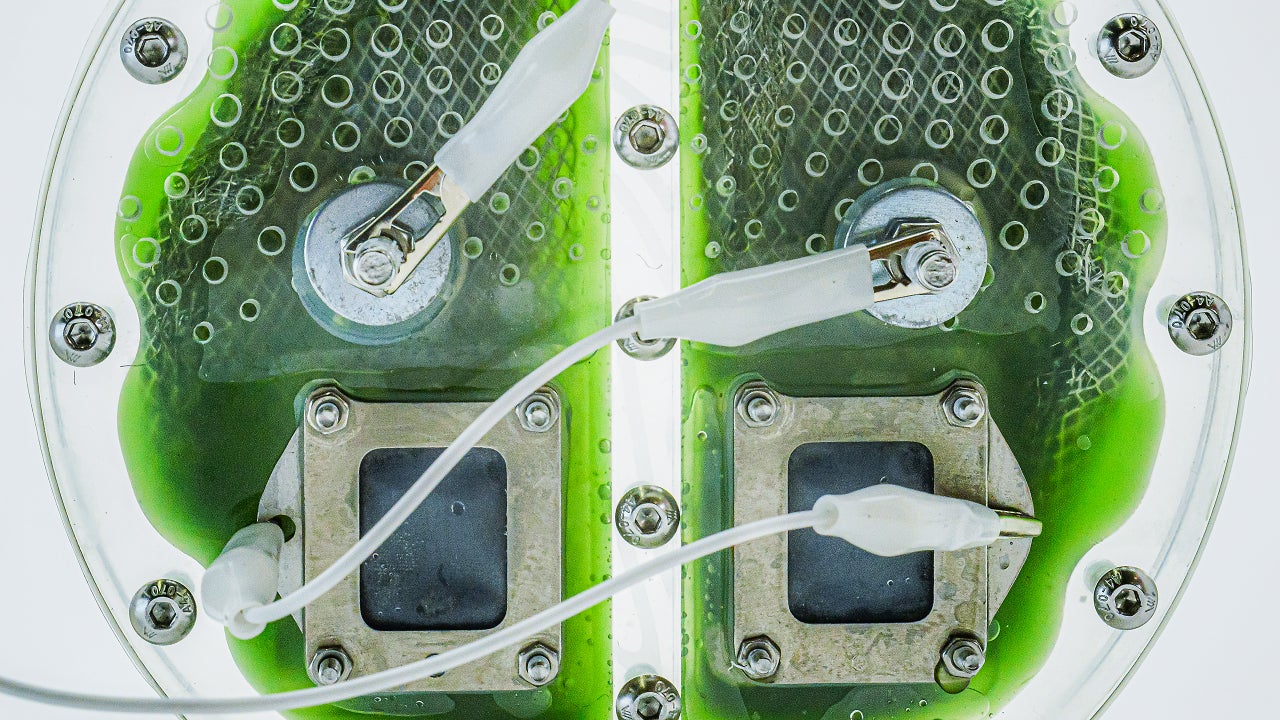
FastCompany: When bio-designer Lucia Giron was on family vacation at an island off the coast of North Carolina, a tropical storm flooded the shore, leaving behind small pools of water in the sand. “I remember going to the sea at night and when we stepped in the little puddles they glowed beneath us, and then as the waves were coming in, there was also this sort of glow,” Giron says. “That always stuck with me just as a sort of like memory, one of those moments where you are kind of in awe of a natural phenomena.” [Photo: Lucia Giron] Giron didn’t know it at the time, but the source of the bioluminescence was a specific bacteria in the water.
Her beachfront observation sparked a fascination with how design (which she was studying at the time) interacted with biology. It inspired one of her most recent projects, an algae-powered battery that provides a greener alternative to conventional alkaline batteries. The battery seems like straight out of a sci-fi movie: A transparent acrylic chamber holds aquatic cyanobacteria, sometimes called blue-green algae, and it’s encased within a metal frame. It’s compact enough to fit within the palm of your hand. Its form allows in light for the organisms to undergo photosynthesis, as well as providing way for users to see the process itself.
It’s strong enough to power a digital clock and a temperature sensor. (From Left) Lucia Giron, Chris Howe and Dr. Paolo Bombelli with biocell powered clock 2. [Photo: Jacqueline Garget] The algae battery began as a project of Cambridge researcher Dr. Paolo Bombelli who, alongside professor Chris Howe, was conducting research on biophotovoltaics, a green technology that extracts energy from photosynthesis. Bombelli and Howe—who hope to use the technology to possibly replace less sustainable forms of energy—already had a working prototype of the battery.
It looked more like test tubes at the time, so they brought in Giron and the electrical engineer Lifu Tan to help turn the tech into a covetable consumer product. The latest iteration comes after two prior prototypes. The battery harnesses excess electrons released during the algae’s photosynthesis process, capturing them using conductive substances. Since the tech uses a naturally occurring process from an organism but does not extract all of the energy produced, it allows the algae to endure.
“The organism can continue to thrive in its environment and photosynthesize while we’re still extracting small amounts of electricity,” Giron explains. If the concept works, it could mean infinitely rechargeable batteries free of toxic chemicals. [Photo: Lucia Giron] It’s a difficult design challenge. Giron and the team are not only designing a working battery, but an environment where an organism can survive and thrive, which posed its own significant hurdles. There’s a delicate balance involved in harvesting energy from plants.
Contrary to photovoltaics, which crave immense amounts of sunlight, too much sun exposure could harm the living organism. “You could actually unintentionally kill it by putting it in complete direct sun the way you would a solar panel,” Giron says. Additionally, the team had to find materials for the prototype that allowed the algae to take in carbon dioxide and release oxygen back out, but not evaporation. “I think it’s quite nice to be able to like see the system that you’re interacting with and to be able to see where this electricity is coming from,” Giron says. [Photo: Lucia Giron] Aesthetics were important, too.
Article truncated for readability. Read the full piece →
The algae-powered battery represents a significant innovation in sustainable technology, which is highly relevant for brands looking to enhance their eco-friendly image and appeal to consumers.