Score
They’re cheap, they’re kitschy, and investment bankers love them
The article explores the phenomenon of 'deal toys'—kitschy trinkets that investment bankers use to commemorate successful transactions. These toys, which have evolved from simple newspaper ads to elaborate 3D-printed designs, serve as both a symbol of achievement and a form of 'desktop advertisement' for banks, reinforcing their brand identity among clients. Brand strategists can take note of how these tangible tokens of success enhance brand loyalty and recognition within the competitive finance industry.
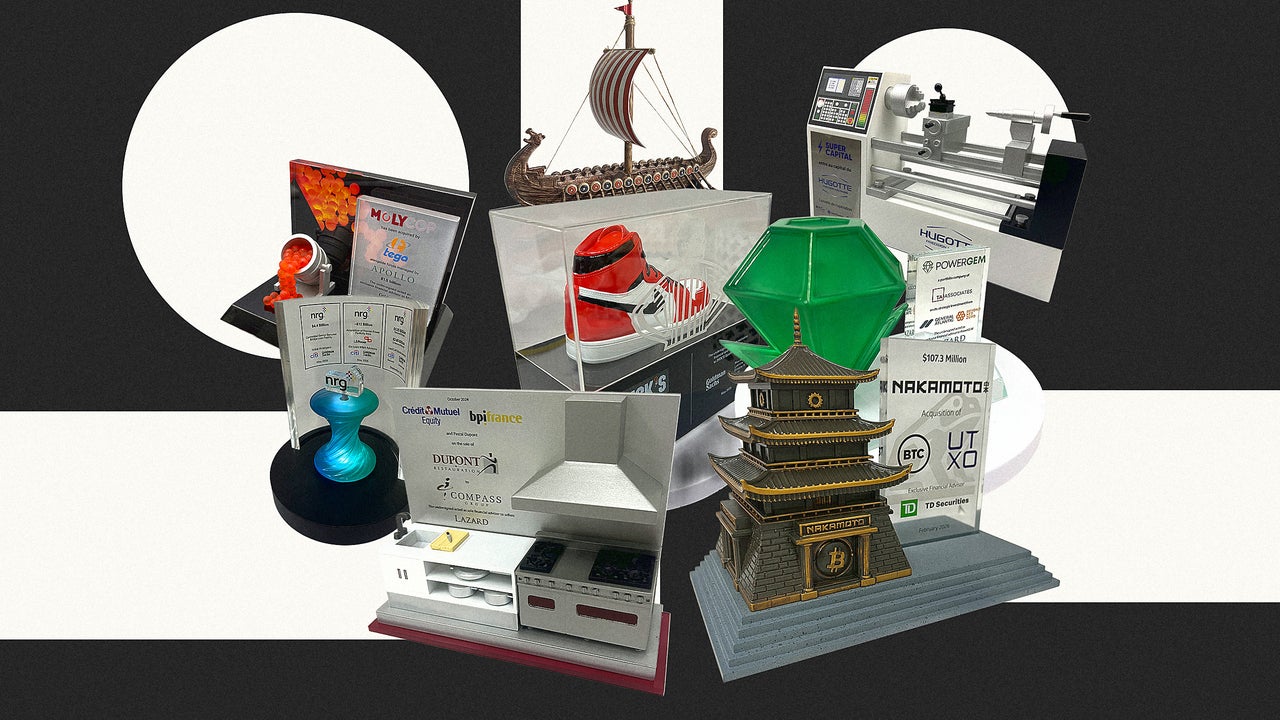
FastCompany: When strolling the hallways of his first internship in investment banking, Alex R. kept noticing small trinkets crowding the desks of executives and junior analysts alike, as if each workstation grew its own skyline made up of knickknacks. Some were simple: glass prisms the size of a coffee mug with a company’s name and the bank’s logo etched on the surface. But others were much flashier. Some were adorned with 3D-printed elements, floating features, and specialized lighting. The awards’ silhouettes sometimes took the form of the Bitcoin logo, a game console, or even a Japanese temple.
[Photo: Courtesy HV Recognition] Alex, who is now a full-time investment banker in New York City, wondered what these eccentric objects were. He sheepishly broached the topic with an analyst on the team, not wanting to look uninitiated. “I asked them, ‘What are these things?’” he tells Fast Company .
(Alex’s last name as well as those of other bankers mentioned have been redacted due to fear of professional repercussions.) For an industry whose public image is one of intensity (see the ego-driven, viciously competitive characters in Industry or the Wolf of Wall Street ), the idea of the grown men behind million-dollar deals swooning over tiny desktop trinkets seems absurd. Especially when flashier perks like steak dinners at Casa Cipriani, bottles of Dom Perignon, and sometimes even the occasional Rolex are considered normal industry rewards. But for many, it is the $100-a-piece deal toy that they covet the most.
Taking many shapes and sizes, the figurines serve as a sort of participation trophy for the closure of a transaction—a memento for those involved in a deal and the bank’s clients. To anyone outside the finance universe, the concept of deal toys is foreign, but within the industry the toys often become one of the highest signifiers of success for young analysts. So much so, when two investment bankers in their mid-twenties overheard a conversation about deal toys, they lit up with joy—mixed with confusion over why “normies” knew, or cared about, their tradition at all. “How did you hear about this in the first place?” one asked.
The other chimed in, “I forget people don’t know these exist.” [Photo: Courtesy HV Recognition] The art of the deal toy Before deal toys existed, bankers had newspaper clippings to commemorate their work. The deals appeared in the form of newspaper tombstone ads to adhere to the Securities and Exchange Commission’s requirement to publicly disclose big deals like initial public offerings. The brief ads, which ran in publications like The Wall Street Journal or the Financial Times, were basic in style, listing the underwriters for a deal and brief details on the transaction.
Eventually, though no one can say exactly when, the tombstone came off the page and moved to the desk. (The name tombstone has evolved to become a synonym for a deal toy.) At some point in the 1970s, bankers looked for a more permanent recognition outside of a tiny newspaper ad that could get thrown out. “They started simply taking a digital print, a card cut out with all the deal information on it, and they would embed it into . . .
Article truncated for readability. Read the full piece →
While the concept of deal toys is niche and specific to the finance industry, it offers insights into brand reinforcement and loyalty that can be valuable for brand strategists.
Weekly digest
Get the Signal digest
Every Monday morning — the top 3 brand trends, 10 high-signal articles, and one emerging signal to watch.
No spam. Unsubscribe anytime.