Score
These ingenious new robots are helping fishing crews catch salmon more humanely and sustainably
The introduction of the Poseidon S robot by Shinkei Systems represents a significant advancement in the fishing industry, focusing on humane and sustainable practices. By automating the fish harvesting process, Shinkei not only enhances the quality and shelf life of seafood but also aligns with growing consumer demand for ethically sourced products, thus reshaping brand strategy in the seafood market.
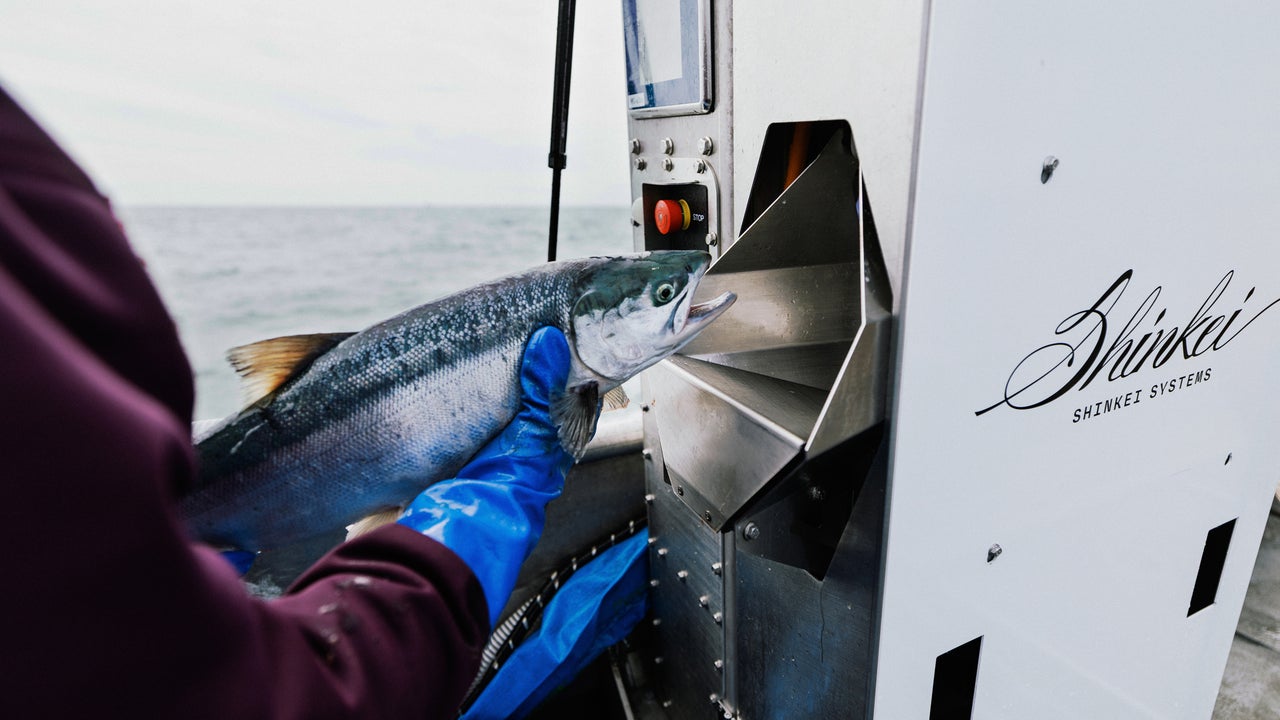
FastCompany: Right now, sockeye salmon season is peaking in Alaska. Some fishing vessels in the Cook Inlet have welcomed a new crew member, one who doesn’t complain about swells, eat, or even sleep—yet is able to harvest salmon more rapidly and humanely than any fisherman ever has. The newcomer is Poseidon S, a robot built by a startup called Shinkei Systems. Poseidon’s process sounds coldly mechanical but is in fact far more compassionate than the traditional methods, which often leave fish to slowly asphyxiate on deck.
As crews aboard Shinkei’s partner boats navigate the inlet—notorious for its treacherous tidal waters—they hand feed salmon they’ve caught into the robot, a tall metal box bolted to the deck. Inside, computer vision helps the machine identify the species, locate a half-inch spot on the skull, and drive a spike through the hindbrain before severing the gills. The whole cycle takes about seven seconds, depositing the fish in ice before it can thrash.
[Photo: Matt & Alex Lowber/LOBO] “We’re basically doing the equivalent of surgery on these fish in a very difficult maritime environment,” Shinkei’s founder, Saif Khawaja, said as we watched footage of the process together recently over a Zoom call. The Shinkei model The Poseidon replicates ike jime and shinkei jime , the exacting slaughter techniques long required for fish served at top sushi restaurants in Tokyo, Los Angeles, and New York. The method is hands-down the most humane way to kill a fish. Not incidentally, chefs at high-end restaurants including Daniel and Atelier Crenn believe Shinkei fish simply taste better.
Shinkei is an El Segundo, California-based company that Khawaja founded four years ago in New York, before coming to believe that all the serious engineers are in California. (Significantly, and in keeping with the company ethos, the Japanese word shinkei translates as “sensitive.”) Shinkei installs the Poseidon S robot for free and pays fishermen a premium for their catch. In exchange, it takes full possession of the fish, keeping it off the open market. The company then processes, distributes, and sells the seafood itself, under its own consumer brand, Seremoni.
[Photo: Matt & Alex Lowber/LOBO] Until this summer, Shinkei was using this method to process just a handful of fish types that most American consumers don’t eat very often: black cod, black sea bass, red snapper, vermilion rockfish. This was by design, Khawaja tells me: “We chose to avoid the most popular fish in the American diet” to show “what we could do with beautiful, artisanal noncommodity fish.” Now, Poseidon is being deployed toward the most popular fish in the country, which Shinkei says will begin rolling out at restaurants and retail partners in the coming weeks.
Last year, 200 million salmon were harvested in Alaska during the brief fishing season, and Americans put away 200,000 metric tons, making them the planet’s number one consumer. [Photo: Matt & Alex Lowber/LOBO] The case for Poseidon S Poseidon S’s predecessor, the full-sized Poseidon, has won attention for its innovations in animal welfare and sustainability (including a spot on Fast Company ’s 2026 list of the Most Innovative Companies in Food). The robot helps mitigate the guilt that people feel about eating creatures that feel pain.
Article truncated for readability. Read the full piece →
The introduction of a robot that enhances humane and sustainable fishing practices is significant for the seafood industry and brand strategies, especially as consumer demand for ethical sourcing grows.
Weekly digest
Get the Signal digest
Every Monday morning — the top 3 brand trends, 10 high-signal articles, and one emerging signal to watch.
No spam. Unsubscribe anytime.